Showing posts with label book: 1784 Bewick. Show all posts

Bewick's Select Fables of Aesop

Bewick's Select Fables of Aesop and others in three parts, "faithfully reprinted from the rare Newcastle edition published by T. Saint in 1784," and published in 1871. You can use this link to browse posts from this book, and you will find the table of contents below.

Note: Book 3 contains long fables in verse, which I have not included in this project, but you can read them in the online book: Fables in Verse.

online source: Internet Archive

Here's a random image from the book:


Table of Contents:


Here's a random fable from the book:


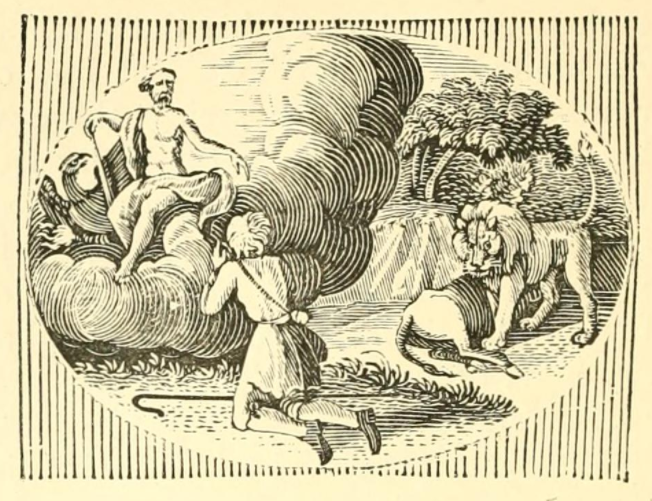
Jupiter and the Herdsman


2.67. JUPITER AND THE HERDSMAN. A Herdsman, missing a young heifer that belonged to his herd, went up and down the forest to seek it. And having walked a great deal of ground to no purpose, he fell a praying to Jupiter for relief; promising to sacrifice a Kid to him, if he would help him to a discovery of the thief. After this, he went on a little farther, and came near a grove of oaks, where he found the carcase of his heifer, and a lion grumbling over it, and feeding upon it. This sight almost scared him out of his wits; so down he fell upon his knees once more, and addressing himself to Jupiter; O Jupiter! says he, I promised thee a Kid to show me the thief, but now I promise thee a bull, if thou wilt be so merciful as to deliver me out of his clutches.
MORAL. We ought never to supplicate the Divine power, but through motives of religion and virtue; prayers, dictated by passion or interest, are unacceptable to the Deity. [more info]

The Wanton Calf


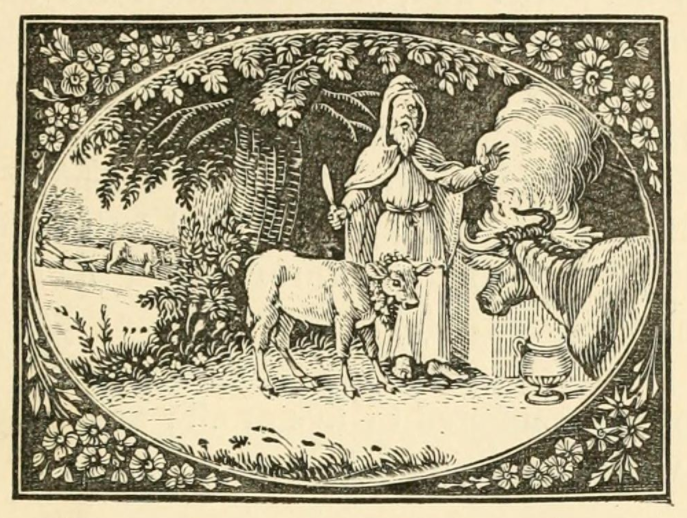
2.66. THE WANTON CALF. A Calf, full of play and wantonness, seeing the Ox at plough, could not forbear insulting him. "What a sorry poor drudge art thou," says he, "to bear that heavy yoke upon your neck, and go all day drawing a plough at your tail, to turn up the ground for your master! But you are a wretched dull slave, and know no better, or else you would not do it. See what a happy life I lead; I go just where I please; sometimes I lie down under the cool shade; sometimes frisk about in the open sunshine; and, when I please, slake my thirst in the clear sweet brook: But you, if you were to perish, have not so much as a little dirty water to refresh you."
The Ox, not at all moved with what he said, went quietly and calmly on with his work: and, in the evening, was unyoked and turned loose. Soon after which he saw the Calf taken out of the field, and delivered into the hands of a priest, who immediately led him to the altar, and prepared to sacrifice him. His head was hung round with fillets of flowers, and the fatal knife was just going to be applied to his throat, when the Ox drew near and whispered him to this purpose: "Behold the end of your insolence and arrogance; it was for this only you were suffered to live at all; and pray now, friend, whose condition is best, yours or mine?"
MORAL. To insult people in distress is the property of a cruel, indiscreet, and giddy temper; for on the next turn of fortune's wheel, we maybe thrown down to their condition, and they exalted to ours. [more info]

The Boy and his Mother


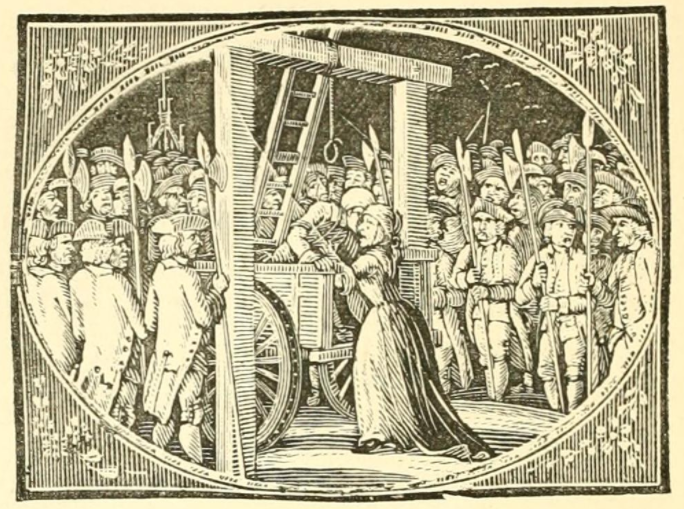
2.65. THE BOY AND HIS MOTHER. A Little Boy, who went to school, stole one of his school-fellow's horn-books, and brought it home to his mother; who was so far from correcting and discouraging him upon account of the theft, that she commended and gave him an apple for his pains. In process of time, as the child grew up to be a man, he accustomed himself to greater robberies; and at last, being apprehended and committed to gaol, he was tried and condemned for a felony. On the day of his execution, as the officers were conducting him to the gallows, he was attended by a vast crowd of people, and among the rest by his mother, who came sighing and sobbing along, and deploring extremely her son's unhappy fate; which the criminal observing, he called to the sheriff, and begged the favour of him, that he would give him leave to speak a word or two to his poor afflicted mother. The sheriff (as who would deny a dying man so reasonable a request) gave him permission; and the felon, while everyone thought he was whispering something of importance to his mother, bit off her ear, to the great offence and surprise of the whole assembly. "What, say they, was not this villain contented with the impious acts which he has already committed, but he must increase the number of them, by doing this violence to his mother?"
"Good people," replied he, "I would not have you be under a mistake; that wicked woman deserves this, and even worse at my hands; for if she had chastised and chid, instead of rewarding and caressing me, when in my infancy I stole the horn-book from the school, I had not come to this ignominious untimely end."
MORAL. Youthful minds, like the pliant wax, are susceptible of the most lasting impressions, and the good or evil bias they then receive is seldom or ever eradicated. [more info]

The Collier and the Fuller


2.64. THE COLLIER AND THE FULLER. The Collier and the Fuller, being old acquaintance, happened upon a time to meet together; and the latter, being but ill provided with a habitation, was invited by the former to come and live in the same house with him. I thank you, my dear friend, replies the Fuller, for your kind offer, but it cannot be; for if I were to dwell with you, whatever I should take pains to scour and make clean in the morning, the dust of you and your coals would blacken and defile, as bad as ever before night.
MORAL. We commonly imbibe the principles and manners of those with whom we associate. [more info]

The Proud Frog


2.62. THE PROUD FROG. An Ox, grazing in a meadow, chanced to set his foot among a parcel of young frogs, and trod one of them to death. The rest informed their mother, when she came home, what had happened; telling her, that the beast which did it was the hugest creature that ever they saw in their lives.
"What, was it so big?" says the old Frog, swelling and bowing up her speckled belly to a great degree.
"Oh, bigger by a vast deal," say they.
"And so big?" says she, straining herself yet more.
"Indeed, Mamma," say they, "if you were to burst yourself, you would never be so big."
She strove yet again, and burst herself indeed.
MORAL. The silly ambition of vying with our superiors, in station and fortune is the direct road to ruin. [more info]

The Dog and the Sheep


2.61. THE DOG AND THE SHEEP. The Dog sued the Sheep for a debt, of which the Kite and the Wolf were to be judges. They, without debating long upon the matter, or making any scruple for want of evidence, gave sentence for the plaintiff; who immediately tore the poor Sheep in pieces, and divided the spoil with the unjust judges.
MORAL. We cannot reasonably hope for justice in a court, where the judges are interested in the decision. [more info]

Two Young Men and the Cook


2.60. TWO YOUNG MEN AND THE COOK. Two young men went into a cook's shop, under pretence of buying meat; and while the cook's back was turned, one of them snatched up a piece of beef, and gave it to his companion, who presently clapt it under his cloak. The cook turning about again, and missing his beef, began to charge them with it; upon which, he that first took it, swore bitterly he had none of it. He that had it swore as heartily, that he had taken up none of his meat. Why look ye, gentlemen, says the cook, I see your equivocation; and though I can't tell which of you has taken my meat, I am sure, between you both, there's a thief, and a couple of rascals.
Thus quibbling thieves evade the charge,
Offend the laws, and go at large:
But though 'tis hard the crime to fix,
We know they're guilty by their tricks.
[more info]

The Old Hound


2.59. THE OLD HOUND. An old Hound, who had been an excellent good one in his time, and given his master great sport and satisfaction in many a chase, at last, by the effect of years, became feeble and unserviceable. However, being in the field one day, when the Stag was almost run down, he happened to be the first that came in with him, and seized him by one of his haunches; but, his decayed and broken teeth not being able to keep their hold, the Deer escaped, and threw him quite out. Upon which, his master, being in a great passion, was going to strike him, when the honest old creature is said to have barked out his apology: Ah! do not strike your poor old servant; it is not my heart and inclination, but my strength and speed that fail me. If what I now am displeases, pray don't forget what I have been.
MORAL. Useful services, performed in youth, ought not to be cancelled by old age and infirmities. [more info]

The Cat and the Fox


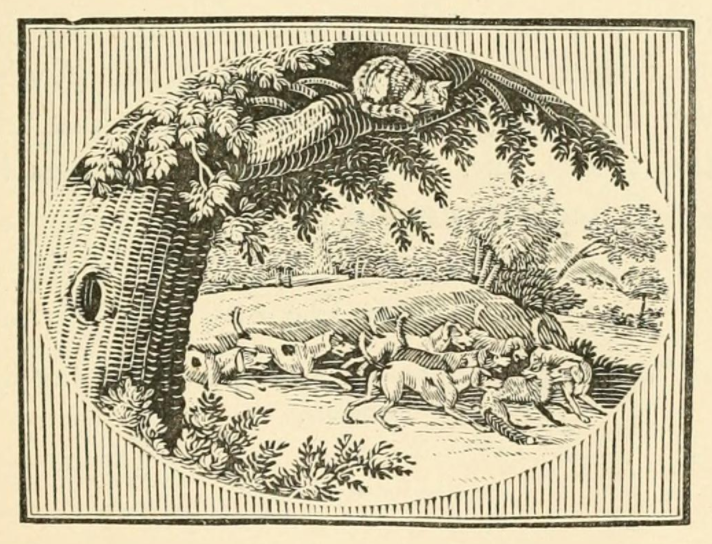
2.58. THE CAT AND THE FOX. As the Cat and the Fox were talking politics together, on a time, in the middle of the forest, Reynard said, Let things turn out ever so bad, he did not care, for he had a thousand tricks for them yet before they should hurt him. "But pray," says he, "Mrs Puss, suppose there should be an invasion, what course do you design to take?"
"Nay," says the Cat, "I have but one shift for it; and if that won't do, I am undone."
"I am sorry for you," replies Reynard, "with all my heart, and would gladly furnish you with one or two of mine, but indeed, neighbour, as times go, it is not good to trust; we must even be every one for himself, as the saying is, and so your humble servant."
These words were scarce out of his mouth, when they were alarmed with a pack of hounds that came upon them full cry. The Cat, by the help of her single shift, ran up a tree, and sat securely among the top branches; from whence she beheld Reynard, who had not been able to get out of sight, overtaken with his thousand tricks, and torn in as many pieces by the dogs which had surrounded him.
MORAL. Successful cunning often makes an ostentatious pretension to wisdom. [more info]

The Sparrow and the Hare


2.57. THE SPARROW AND THE HARE. A Hare, being seized by an Eagle, squeaked out in a most woeful manner. A Sparrow that sat upon a tree just by and saw it, could not forbear being unseasonably witty, but called out, and said to the Hare: "So ho! what! sit there and be killed? Pr'ythee, up and away; I dare say, if you would but try, so swift a creature as you are would easily escape from the Eagle." As he was going on with his cruel raillery, down came a Hawk, and snapt him up; and, notwithstanding his vain cries and lamentations, fell a devouring of him in an instant. The Hare, who was just expiring, yet received comfort from this accident, even in the agonies of death; and, addressing her last words to the Sparrow, said: "You, who just now insulted my misfortune with so much security, as you thought, may please to shew us how well you can bear the like, now it has befallen you."
MORAL. The mutability of human affairs is such, that no situation, however seemingly advantageous, ought to make us jest with the misfortunes of others. [more info]

The Two Pots


2.56. THE TWO POTS. An earthen pot and one of brass, standing together upon the river's brink, were both carried away by the flowing in of the tide. The earthen pot showed some uneasiness, as fearing he should be broken; but his companion of brass bid him be under no apprehensions, for that he would take care of him. Oh! replies the other, keep as far off as ever you can, I entreat you; it is you I am most afraid of: For, whether the stream dashes you against me, or me against you, I am sure to be the sufferer; and therefore, I beg of you, do not let us come near one another.
MORAL. Reciprocal pleasure and advantage is the only rational foundation for real friendship. [more info]

The Sick Kite


2.55. THE SICK KITE. A Kite had been sick a long time; and finding there were no hopes of recovery, begged of his mother to go to all the churches and religious houses in the country, to try what prayers and promises would effect in his behalf. The old Kite replied: Indeed, dear Son, I would willingly undertake anything to save your life, but I have great reason to despair of doing you any service in the way you propose: For, with what face can I ask anything of the Gods in favour of one whose whole life has been a continued scene of rapine and injustice, and who has not scrupled upon occasion to rob the very altars themselves?
MORAL. After a long life spent in acts of impiety and wickedness, we may justly suspect the sincerity of a death-bed repentance. [more info]

Hercules and the Carter


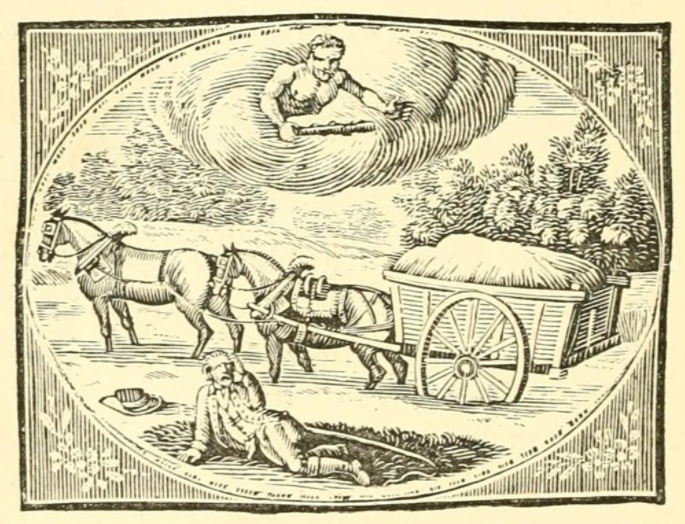
2.54. HERCULES AND THE CARTER. As a clownish fellow was driving his Cart along a deep miry lane, the wheels stuck so fast in the clay, that the horses could not draw them out. Upon this, he fell a bawling and praying to Hercules to come and help him. Hercules looking down from a cloud, bid him not lie there, like an idle rascal as he was, but get up and whip his horses stoutly, and clap his shoulder to the wheel, adding, that this was the only way for him to obtain his assistance.
Inactive wishes are but waste of time,
And, without efforts, prayers themselves a crime:
Vain are their hopes who miracles expect,
And ask from heaven what themselves neglect.
[more info]

The Thief and the Dog


2.53. THE THIEF AND THE DOG. A Thief coming to rob a certain house in the night, was disturbed in his attempts by a fierce vigilant dog who kept barking at him continually. Upon which the thief, thinking to stop his mouth, threw him a piece of bread: But the dog refused it with indignation; telling him, that before, he only suspected him to be a bad man; but now, upon his offering to bribe him, he was confirmed in his opinion; and that, as he was entrusted with the guardianship of his master's house, he should never cease barking while such a rogue as he lay lurking about it.
MORAL. Nothing can alter the honest purposes of the man, who despises an insidious bribe; and whose mind is proof against temptation. [more info]

The Two Frogs


2.52. THE TWO FROGS. One hot sultry summer, the lakes and ponds being almost everywhere dried up, a couple of Frogs agreed to travel together in search of water. At last they came to a deep well, and sitting upon the brink of it, began to consult, whether they should leap in or no. One of them was for it; urging, that there was plenty of clear spring water, and no danger of being disturbed. Well, says t'other, all this may be true; and yet I can't come into your opinion for my life: For, if the water should happen to dry up here too, how should we get out again?
On things of moment with thyself debate,
Nor, inconsiderate, change thy present state,
Nor on the specious good lay too much stress,
Lest greater Ills incur, in shunning less.
[more info]

The Mountains in Labor


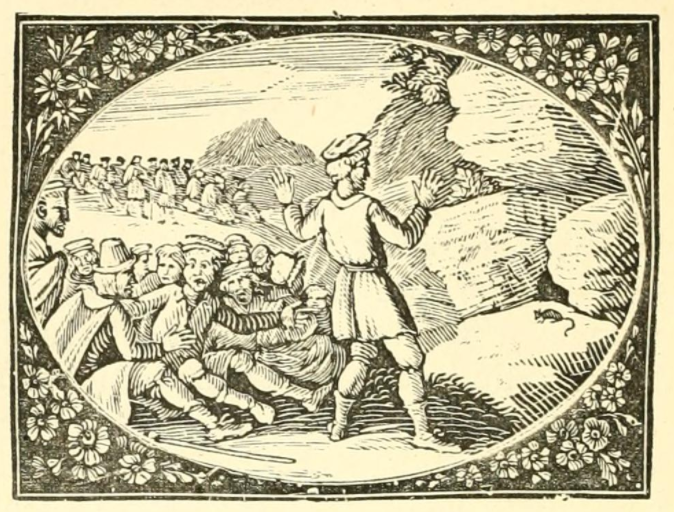
2.51. THE MOUNTAINS IN LABOR. The Mountains were said to be in labour, and uttered most dreadful groans. People came together, far and near, to see what birth would be produced; and after they had waited a considerable time in expectation, out crept a mouse.
Thus the vain Alchymist, in promise bold,
Beholds projection big with MINES of GOLD:
But now, his glasses burst, he thinks him rich
To save a little oil to cure the itch.
[more info]

The Viper and the File


2.50. THE VIPER AND THE FILE. A Viper entering a smith's shop, looked up and down for something to eat, and seeing a File, fell to gnawing it as greedily as could be. The File told him, very gruffly, that he had best be quiet and let him alone; for that he would get very little by nibbling at one, who, upon occasion, could bite iron and steel.
Witlings! Beware, nor wantonly provoke
Those who with interest may repay the joke.
[more info]

The Fox and the Grapes


2.49. THE FOX AND THE GRAPES. A Fox, very hungry, chanced to come into a Vineyard, where there hung many bunches of charming ripe grapes; but nailed up to a trellis so high, that he leaped till he quite tired himself without being able to reach one of them. At last, Let who will take them! says he; they are but green and sour; so I'll even let them alone.
MORAL. When a man finds it impossible to obtain the things he longs for, it is a mark of sound wisdom and discretion to make a virtue of necessity. [more info]

The Crow and the Pitcher


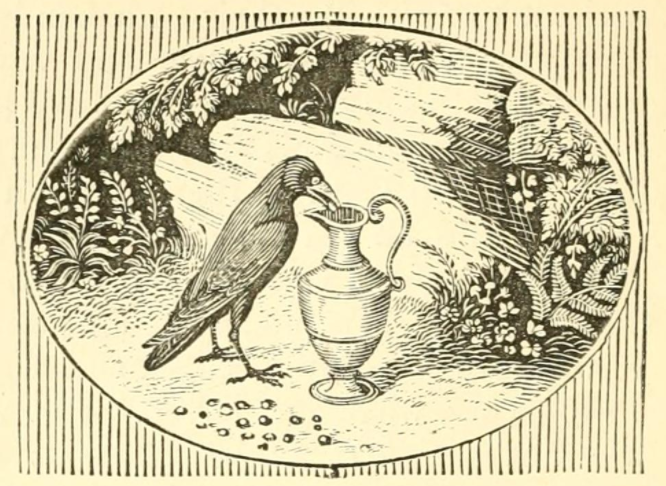
2.48. THE CROW AND THE PITCHER. A Crow, ready to die with thirst, flew with joy to a pitcher which he beheld at some distance. When he came, he found water in it indeed, but so near the bottom, that with all his stooping and straining, he was not able to reach it. Then he endeavoured to overturn the pitcher, that so at least he might be able to get a little of it; but his strength was not sufficient for this. At last, seeing some pebbles lie near the place, he cast them one by one into the pitcher; and thus, by degrees, raised the water up to the very brim, and satisfied his thirst.
MORAL. What we cannot compass by force, we may by invention and industry. [more info]