Showing posts with label index: Perry 285. Show all posts

The Man and the God of Wood


6.06. De homine et ligneo deo
Caxton: Of the man and of the god of the wodes
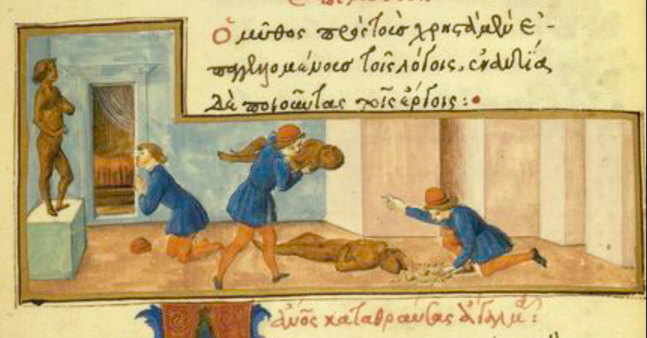
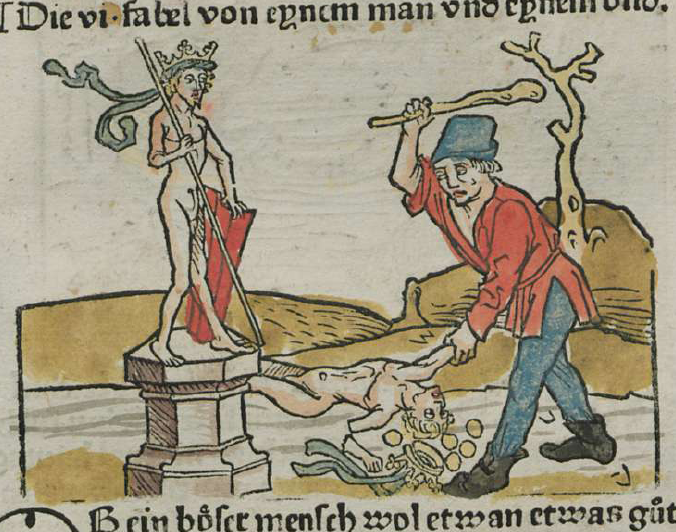
Of the euylle man somtyme prouffiteth somme other / he doth hit not by his good wylle / but by force / As reherceth to vs this fable / Of a man whiche had in his hows an ydolle the whiche oftyme he adoured as his god / to whome ofte he prayd that he wold gyue to hym moche good And the more that he prayd hym / the more he faylled / and became pouere / wherfore the man was wel wrothe ageynst his ydolle / and took hit by the legges / and smote the hede of hit so strongly ageynst the walle / so that it brake in to many pyeces / Oute of the whiche ydolle yssued a ryght grete tresoure / wherof the man was ful gladde and Ioyous / And thenne the man sayd to his ydolle / Now knowe I wel / that thou art wycked / euyl and peruers / For whanne I haue worshipped the / thow hast not holpen me / And now whanne I haue bete the / thow hast moche done for me /
And therfore the euylle man whanne he doth ony good / it is not of his good wylle / but by force /
[more info]

The Man who Broke the Statue


124. THE MAN WHO BROKE THE STATUE. You will find the fable in English on this page; scroll to see if there are multiple English versions. [more info]

The Man and his Wooden God


113. THE MAN AND HIS WOODEN GOD. A man, having a wooden god, worshipped it every day; and, among other things, prayed particularly for wealth. because his circumstances were but low. But when he had continued to do this for many days to no purpose, in a passion at the disappointment, he took the image by the legs, knocked it against the pavement, and broke it in pieces, upon which a great quantity of money, which had been enclosed within it, flew about the room.
The man no sooner perceived this, but addressing himself to the idol, “Thou obstinate, perverse deity,” says he, “who, while I humbly besought thee, hadst no regard to my prayers, but now thou art used ill, and broken to pieces, dost pour forth good things, in even a greater abundance than I could desire.” [more info]

The Man and the Wooden God


04.08: THE MAN AND THE WOODEN GOD.
A pagan kept a god of wood,—
A sort that never hears,
Though furnish'd well with ears,—
From which he hoped for wondrous good.
The idol cost the board of three;
So much enrich'd was he
With vows and offerings vain,
With bullocks garlanded and slain:
No idol ever had, as that,
A kitchen quite so full and fat.
But all this worship at his shrine
Brought not from this same block divine
Inheritance, or hidden mine,
Or luck at play, or any favour.
Nay, more, if any storm whatever
Brew'd trouble here or there,
The man was sure to have his share,
And suffer in his purse,
Although the god fared none the worse.
At last, by sheer impatience bold,
The man a crowbar seizes,
His idol breaks in pieces,
And finds it richly stuff'd with gold.
'How's this? Have I devoutly treated,'
Says he, 'your godship, to be cheated?
Now leave my house, and go your way,
And search for altars where you may.
You're like those natures, dull and gross,
From, which comes nothing but by blows;
The more I gave, the less I got;
I'll now be rich, and you may rot.'
[more info]

The Man and the Wooden God


41. THE MAN AND THE WOODEN GOD. In the old days men used to worship stocks and stones and idols, and prayed to them to give them luck. It happened that a Man had often prayed to a wooden idol he had received from his father, but his luck never seemed to change. He prayed and he prayed, but still he remained as unlucky as ever. One day in the greatest rage he went to the Wooden God, and with one blow swept it down from its pedestal. The idol broke in two, and what did he see? An immense number of coins flying all over the place. [more info]

The Man and the Wooden God


010. THE MAN AND THE WOODEN GOD.
A pagan kept a god of wood,—
A sort that never hears,
Though furnish'd well with ears,—
From which he hoped for wondrous good.
The idol cost the board of three;
So much enrich'd was he
With vows and offerings vain,
With bullocks garlanded and slain:
No idol ever had, as that,
A kitchen quite so full and fat.
But all this worship at his shrine
Brought not from this same block divine
Inheritance, or hidden mine,
Or luck at play, or any favour.
Nay, more, if any storm whatever
Brew'd trouble here or there,
The man was sure to have his share,
And suffer in his purse,
Although the god fared none the worse.
At last, by sheer impatience bold,
The man a crowbar seizes,
His idol breaks in pieces,
And finds it richly stuff'd with gold.
'How's this? Have I devoutly treated,'
Says he, 'your godship, to be cheated?
Now leave my house, and go your way,
And search for altars where you may.
[more info]