Showing posts with label book: 1667 Phaedrus. Show all posts

Laurentius's Phaedrus (1667)

Phaedri Fabularum libri quinque: The Five Books of the Fables of Phaedrus, edited by Johannes Laurentius with engravings by Christopher Hagens, published in 1667.

online source: Internet Archive

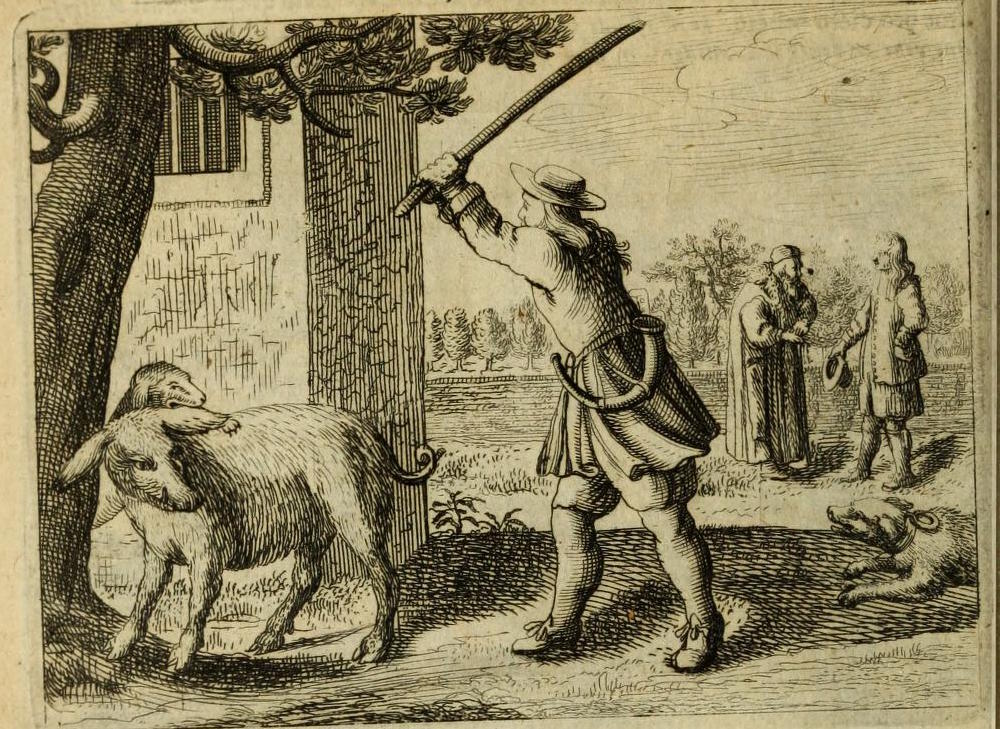
This book is in Latin, so for the text I have used Christopher Smart's verse translation of Phaedrus, which you can find at Project Gutenberg. Smart omits some fables that he found to be too crude, including the woman in childbirth, the ass insulting the boar, the ominous sheep (one of my personal favorites), and the dog ambassadors to Jupiter (another personal favorite). I will find other translations to use for those.

Here's a random image from the book:


1.01. THE WOLF AND THE LAMB.
1.02. THE FROGS DESIRING A KING.
1.03. THE VAIN JACKDAW.
1.04. THE DOG IN THE RIVER.
1.05. THE HEIFER, GOAT, SHEEP, AND LION.
1.06. THE FROGS AND SUN.
1.07. THE FOX AND THE TRAGIC MASK.
1.08. THE WOLF AND CRANE.
1.09. THE HARE AND THE SPARROW.
1.10. THE WOLF AND FOX, WITH THE APE FOR JUDGE.
1.11. THE ASS AND THE LION HUNTING.
1.12. THE STAG AT THE FOUNTAIN.
1.13. THE FOX AND THE CROW.
1.14. THE COBBLER TURNED DOCTOR.
1.15. THE SAPIENT ASS.
1.16. THE SHEEP, THE STAG, AND THE WOLF.
1.17. THE SHEEP, THE DOG, AND THE WOLF.
1.18.  THE BITCH AND HER PUPPIES.
1.19. THE HUNGRY DOGS.
1.20. THE OLD LION.
1.21. THE MAN AND THE WEASEL.
1.22. THE FAITHFUL HOUSE-DOG.
1.23. THE PROUD FROG.
1.24. THE DOG AND THE CROCODILE.
1.25. THE FOX AND THE STORK.
1.26. THE DOG, TREASURE, AND VULTURE.
1.27. THE FOX AND EAGLE.
1.28. THE FROGS AND BULLS.
1.29. THE KITE AND THE DOVES.
2.01. THE JUDICIOUS LION.
2.02. THE BALD-PATE DUPE.
2.03. THE MAN AND THE DOG.
2.04. THE EAGLE, THE CAT, AND THE SOW.
2.05. CÆSAR AND HIS SLAVE.
2.06. THE EAGLE, CARRION CROW, AND TORTOISE.
2.07. THE MULES AND ROBBERS.
2.08. THE STAG AND THE OXEN.
3.01. THE OLD WOMAN AND EMPTY CASK.
3.02. THE PANTHER AND SHEPHERDS.
3.03. THE APE’S HEAD.
3.04. ESOP AND THE INSOLENT FELLOW.
3.05. THE FLY AND THE MULE.
3.06. THE DOG AND THE WOLF.
3.07. THE BROTHER AND SISTER.
3.08. A SAYING OF SOCRATES.
3.09. OF DOUBT AND CREDULITY.
3.10. THE COCK AND THE PEARL.
3.11. THE BEES AND THE DRONES.
3.12. ESOP PLAYING.
3.13. THE DOG AND THE LAMB.
3.14. THE OWL AND THE GRASSHOPPER.
3.15. THE TREES PROTECTED.
3.16. JUNO AND THE PEACOCK.
3.17. ESOP AND THE IMPORTUNATE FELLOW.
3.18. THE ASS AND PRIESTS OF CYBELE.
4.01. THE WEAZEL AND MICE.
4.02. THE FOX AND THE GRAPES.
4.03. THE HORSE AND BOAR.
4.04. ESOP AND THE WILL.
4.05. THE BATTLE OF THE MICE AND WEASELS.
4.06. THE VIPER AND THE FILE.
4.07. THE FOX AND THE GOAT.
4.08. THE TWO BAGS.
4.09. THE SACRILEGIOUS THIEF.
4.10. HERCULES AND PLUTUS.
4.11. THE HE-GOATS AND SHE-GOATS.
4.12. THE PILOT AND SAILORS.
4.13. THE MAN AND THE ADDER.
4.14. THE FOX AND THE DRAGON.
4.15. THE SHIPWRECK OF SIMONIDES.
4.16. THE MOUNTAIN IN LABOR.
4.17. THE ANT AND THE FLY.
4.18. THE ESCAPE OF SIMONIDES.
5.01. DEMETRIUS AND MENANDER.
5.02. THE THIEF AND THE TRAVELLERS.
5.03. THE BALD MAN AND THE FLY.
5.04. THE MAN AND THE ASS.
5.05. THE BUFFOON AND COUNTRY-FELLOW.
5.06. THE TWO BALD MEN.
5.07. PRINCE THE PIPER.
5.08. OPPORTUNITY.
5.09. THE BULL AND THE CALF.
5.10. THE OLD DOG AND THE HUNTSMAN.

Here's a random fable from the book:


The Old Dog and the Huntsman


5.10. THE OLD DOG AND THE HUNTSMAN.
A Dog, that time and often tried,
His master always satisfied;
And whensoever he assail’d,
Against the forest-beasts prevail’d
Both by activity and strength,
Through years began to flag at length.
One day, when hounded at a boar,
His ear he seized, as heretofore;
But with his teeth, decay’d and old,
Could not succeed to keep his hold.
At which the huntsman, much concern’d,
The vet’ran huff’d, who thus return’d:
“My resolution and my aim,
Though not my strength, are still the same;
For what I am if I am chid,
Praise what I was, and what I did.”
Philetus, you the drift perceive
Of this, with which I take my leave.
[more info]

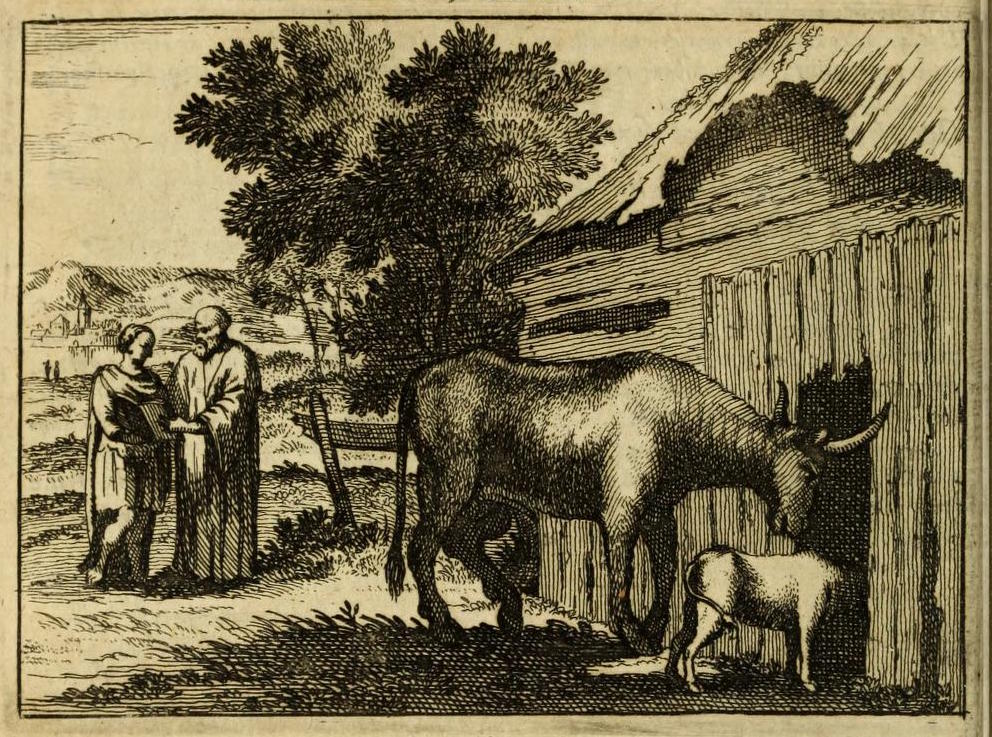
The Bull and the Calf


5.09. THE BULL AND THE CALF.
A Bull was struggling to secure
His passage at a narrow door,
And scarce could reach the rack of hay,
His horns so much were in his way.
A Calf officious, fain would show
How he might twist himself and go.
“Hold thou thy prate; all this,” says he,
“Ere thou wert calved was known to me.”
He, that a wiser man by half
Would teach, may think himself this Calf. [more info]

Opportunity


5.08. OPPORTUNITY.
Bald, naked, of a human shape,
With fleet wings ready to escape,
Upon a razor’s edge his toes,
And lock that on his forehead grows—
Him hold, when seized, for goodness’ sake,
For Jove himself cannot retake
The fugitive when once he’s gone.
The picture that we here have drawn
Is Opportunity so brief.—
The ancients, in a bas-relief,
Thus made an effigy of Time,
That every one might use their prime;
Nor e’er impede, by dull delay,
Th’ effectual business of to-day. [more info]

Prince the Piper


5.07. PRINCE THE PIPER.
A little, friv’lous, abject mind,
Pleased with the rabble, puff’d with wind,
When once, as fast as pride presumes,
Itself with vanity it plumes,
Is by fond lightness brought with ease
To any ridicule you please.
One Prince, a piper to the play,
Was rather noted in his way,
As call’d upon to show his art,
Whene’er Bathyllus did his part.
He being at a certain fair,
(I do not well remember where,)
While they pull’d down the booth in haste,
Not taking heed, his leg displaced,
He from the scaffold fell so hard—
(Would he his pipes had rather marr’d!
Though they, poor fellow! were to him
As dear almost as life and limb).
Borne by the kind officious crowd,
Home he’s conducted, groaning loud.
Some months elapsed before he found
Himself recover’d of his wound:
Meantime, according to their way,
The droll frequenters of the play
Had a great miss of him, whose touch
The dancers’ spirits raised so much.
A certain man of high renown
Was just preparing for the town
Some games the mob to entertain,
When Prince began to walk again;
Whom, what with bribes and pray’rs, his grace
Prevail’d upon to show his face
In this performance, by all means—
And while he waits behind the scenes,
A rumour through the house is spread,
By certain, that “the piper’s dead.”
Others cried out, “The man is here,
And will immediately appear.”
The curtain draws, the lightnings flash,
The gods speak out their usual trash.
An ode, not to the Piper known,
Was to the chorus leader shown,
Which he was order’d to repeat,
And which was closed with this conceit—
“Receive with joy, O loyal Rome,
Thy Prince just rescued from his tomb.”
They all at once stand up and clap,
At which my most facetious chap
Kisses his hand, and scrapes and bows
To his good patrons in the house.
First the equestrian order smoke
The fool’s mistake, and high in joke,
Command the song to be encored;
Which ended, flat upon the board
The Piper falls, the knights acclaim;
The people think that Prince’s aim
Is for a crown of bays at least.
Now all the seats perceived the jest,
And with his bandage white as snow,
White frock, white pumps, a perfect beauty
Proud of the feats he had achieved,
And these high honours he received,
With one unanimous huzza, Poor
Prince was kick’d out of the play. [more info]

The Two Bald Men


5.06. THE TWO BALD MEN.
As on his way a Bald-pate went,
He found a comb by accident;
Another, with a head as bare,
Pursued, and hollow’d for a share.
The first produced the prize, and cried,
“Good Providence was on our side;
But by the strange caprice of Fate,
We’re to no purpose fortunate;
And, as the proverb says, have found
A hobnail, for a hundred pound.”
They by this tale may be relieved
Whose sanguine hopes have been deceived. [more info]

The Buffoon and Country-Fellow


5.05. THE BUFFOON AND COUNTRY-FELLOW.
In ev’ry age, in each profession,
Men err the most by prepossession;
But when the thing is clearly shown,
Is fairly urged, and fully known,
We soon applaud what we deride,
And penitence succeeds to pride.
A certain noble, on a day,
Having a mind to show away,
Invited by reward the mimes
And play’rs and tumblers of the times,
And built a large commodious stage
For the choice spirits of the age:
But, above all, amongst the rest
There came a genius who profess’d
To have a curious trick in store
That never was perform’d before.
Through all the town this soon got air,
And the whole house was like a fair;
But soon his entry as he made,
Without a prompter or parade,
’Twas all expectance and suspense,
And silence gagg’d the audience.
He, stooping down and looking big,
So wondrous well took off a pig,
All swore ’twas serious, and no joke,
For that, or underneath his cloak
He had concealed some grunting elf,
Or was a real hog himself.
A search was made—no pig was found—
With thund’ring claps the seats resound,
And pit, and box, and gall’ries roar
With— “O rare! bravo!” and “encore.”
Old Roger Grouse, a country clown,
Who yet knew something of the town,
Beheld the mimic of his whim,
And on the morrow challenged him
Declaring to each beau and belle
That he this grunter would excel.
The morrow came—the crowd was greater—
But prejudice and rank ill-nature
Usurp’d the minds of men and wenches,
Who came to hiss and break the benches.
The mimic took his usual station,
And squeak’d with general approbation;
Again “Encore! encore!” they cry—
“’Tis quite the thing, ’tis very high.”
Old Grouse conceal’d, amidst this racket,
A real pig beneath his jacket—
Then forth he came, and with his nail
He pinch’d the urchin by the tail.
The tortured pig, from out his throat,
Produced the genuine nat’ral note.
All bellow’d out ’twas very sad!
Sure never stuff was half so bad.
“That like a pig!” each cried in scoff;
“Pshaw! nonsense! blockhead! off! off! off!”
The mimic was extoll’d, and Grouse
Was hiss’d, and catcall’d from the house.
“Soft ye, a word before I go,”
Quoth honest Hodge; and stooping low,
Produced the pig, and thus aloud
Bespoke the stupid partial crowd:
“Behold, and learn from this poor cratur,
How much you critics know of natur!” [more info]

The Man and the Ass


5.04. THE MAN AND THE ASS.
A certain Man, when he had made
A sacrifice, for special aid
To Hercules, and kill’d a swine,
Did for his Ass’s share assign
All the remainder of the corn;
But he, rejecting it with scorn,
Thus said: “I gladly would partake—
But apprehend that life’s at stake;
For he you fatted up and fed
With store of this, is stuck and dead.”
Struck with the import of this tale,
I have succeeded to prevail
Upon my passions, and abstain,
From peril of immod’rate gain.
But, you will say, those that have come
Unjustly by a handsome sum,
Upon the pillage still subsist—
Why, if we reckon up the list,
You’ll find by far the major part
Have been conducted in the cart:
Temerity for some may do,
But many more their rashness rue. [more info]

The Bald Man and the Fly


5.03. THE BALD MAN AND THE FLY.
As on his head she chanced to sit,
A Man’s bald pate a Gadfly bit;
He, prompt to crush the little foe,
Dealt on himself a grievous blow:
At which the Fly, deriding said,
“You that would strike an insect dead
For one slight sting, in wrath so strict,
What punishment will you inflict
Upon yourself, who was so blunt
To do yourself this gross affront?”—
“O,” says the party, “as for me,
I with myself can soon agree.
The spirit of th’ intention’s all;
But thou, detested cannibal!
Blood-sucker! to have thee secured
More would I gladly have endured.”
What by this moral tale is meant
Is—those who wrong not with intent
Are venial; but to those that do
Severity, I think, is due. [more info]

The Thief and the Travelers


5.02. THE THIEF AND THE TRAVELLERS.
Two men equipp’d were on their way;
One fearful; one without dismay,
An able fencer. As they went,
A robber came with black intent;
Demanding, upon pain of death,
Their gold and silver in a breath.
At which the man of spirit drew,
And instantly disarm’d and slew
The Thief, his honor to maintain.
Soon as the rogue was fairly slain,
The tim’rous chap began to puff,
And drew his sword, and stripp’d in buff—
“Leave me alone with him! stand back!
I’ll teach him whom he should attack.”
Then he who fought, “I wish, my friend,
But now you’d had such words to lend;
I might have been confirm’d the more,
Supposing truth to all you swore;
Then put your weapon in the sheath,
And keep your tongue within your teeth,
Though you may play an actor’s part
On them who do not know your heart.
I, who have seen this very day
How lustily you ran away,
Experience when one comes to blows
How far your resolution goes.”
This narrative to those I tell
Who stand their ground when all is well;
But in the hour of pressing need
Abash’d, most shamefully recede. [more info]

Demetrius and Menander


5.01. DEMETRIUS AND MENANDER.
If Esop’s name at any time
I bring into this measured rhyme,
To whom I’ve paid whate’er I owe,
Let all men by these presents know,
I with th’ old fabulist make free,
To strengthen my authority.
As certain sculptors of the age,
The more attention to engage,
And raise their price, the curious please,
By forging of Praxiteles;
And in like manner they purloin
A Myro to their silver coin.
’Tis thus our fables we can smoke,
As pictures for their age bespoke:
For biting envy, in disgust
To new improvements, favors rust;
But now a tale comes in of course,
Which these assertions will enforce.
Demetrius, who was justly call’d
The tyrant, got himself install’d,
And held o’er Athens impious sway.
The crowd, as ever is the way,
Came, eager rushing far and wide,
And, “Fortunate event!” they cried.
The nobles came, the throne address’d:
The hand by which they were oppress’d
They meekly kiss’d, with inward stings
Of anguish for the face of things.
The idlers also, with the tribe
Of those who to themselves prescribe
Their ease and pleasure, in the end
Came sneaking, lest they should offend.
Amongst this troop Menander hies,
So famous for his comedies.
(Him, though he was not known by sight,
The tyrant read with great delight,
Struck with the genius of the bard.)
In flowing robes bedaub’d with nard,
And saunt’ring tread he came along,
Whom, at the bottom of the throng,
When Phalereus beheld, he said:
“How dares that fribble show his head
In this our presence?” he was told—
“It is Menander you behold.”
Then, changed at once from fierce to bland,
He call’d, and took him by the hand. [more info]

The Escape of Simonides


4.18. THE ESCAPE OF SIMONIDES.
Th’ attention letters can engage,
Ev’n from a base degen’rate age,
I’ve shown before; and now shall show
Their lustre in another view,
And tell a memorable tale,
How much they can with heav’n prevail.
Simonides, the very same
We lately had a call to name,
Agreed for such a sum to blaze
A certain famous champion’s praise.
He therefore a retirement sought,
But found the theme on which he wrote
So scanty, he was forced to use
Th’ accustom’d license of the muse,
And introduced and praise bestow’d
On Leda’s sons to raise his ode;
With these the rather making free,
As heroes in the same degree.
He warranted his work, and yet
Could but one third of payment get.
Upon demanding all the due,
“Let them,” says he, “pay t’other two,
Who take two places in the song;
But lest you think I do you wrong
And part in dudgeon—I invite
Your company to sup this night,
For then my friends and kin I see,
’Mongst which I choose to reckon thee.”
Choused and chagrined, yet shunning blame,
He promised, set the hour, and came;
As fearful lest a favour spurn’d
Should to an open breach be turn’d.
The splendid banquet shone with plate,
And preparations full of state
Made the glad house with clamors roar—
When on a sudden at the door
Two youths, with sweat and dust besmear’d,
Above the human form appear’d,
And charged forthwith a little scout
To bid Simonides come out,
That ’twas his int’rest not to stay.—
The slave, in trouble and dismay,
Roused from his seat the feasting bard,
Who scarce had stirr’d a single yard
Before the room at once fell in,
And crush’d the champion and his kin.
No youths before the door are found.—
The thing soon spread the country round;
And when each circumstance was weigh’d,
They knew the gods that visit made,
And saved the poet’s life in lieu
Of those two-thirds which yet were due. [more info]

The Ant and the Fly


4.17. THE ANT AND THE FLY.
An Ant and Fly had sharp dispute
Which creature was of most repute;
When thus began the flaunting Fly:
“Are you so laudible as I?
I, ere the sacrifice is carved,
Precede the gods; first come, first served—
Before the altar take my place,
And in all temples show my face,
Whene’er I please I set me down
Upon the head that wears a crown.
I with impunity can taste
The kiss of matrons fair and chaste.
And pleasure without labor claim—
Say, trollop, canst thou do the same?”
“The feasts of gods are glorious fare.
No doubt, to those who’re welcome there;
But not for such detested things.—
You talk of matron’s lips and kings;
I, who with wakeful care and pains
Against the winter hoard my grains,
Thee feeding upon ordure view.—
The altars you frequent, ’tis true;
But still are driv’n away from thence,
And elsewhere, as of much offence.
A life of toil you will not lead,
And so have nothing when you need.
Besides all this, you talk with pride
Of things that modesty should hide.
You plague me here, while days increase,
But when the winter comes you cease.
Me, when the cold thy life bereaves,
A plenteous magazine receives.
I think I need no more advance
To cure you of your arrogance.”
The tenor of this tale infers
Two very diff’rent characters;
Of men self-praised and falsely vain,
And men of real worth in grain. [more info]

The Mountain in Labor


4.16. THE MOUNTAIN IN LABOR.
The Mountain labor’d, groaning loud,
On which a num’rous gaping crowd
Of noodles came to see the sight,
When, lo! a mouse was brought to light!
This tale’s for men of swagg’ring cast,
Whose threats, voluminous and vast,
With all their verse and all their prose,
Can make but little on’t, God knows. [more info]

The Shipwreck of Simonides


4.15. THE SHIPWRECK OF SIMONIDES.
A man, whose learned worth is known,
Has always riches of his own.
Simonides, who was the head
Of lyric bards, yet wrote for bread,
His circuit took through every town
In Asia of the first renown,
The praise of heroes to rehearse,
Who gave him money for his verse.
When by this trade much wealth was earn’d,
Homewards by shipping he return’d
(A Cean born, as some suppose):
On board he went, a tempest rose,
Which shook th’ old ship to that degree,
She founder’d soon as out at sea.
Some purses, some their jewels tie
About them for a sure supply;
But one more curious, ask’d the seer,
“Poet, have you got nothing here?”
“My all,” says he, “is what I am.”—
On this some few for safety swam
(For most o’erburden’d by their goods,
Were smother’d in the whelming floods).
The spoilers came, the wealth demand,
And leave them naked on the strand.
It happen’d for the shipwreck’d crew
An ancient city was in view,
By name Clazomena, in which
There lived a scholar learn’d and rich,
Who often read, his cares to ease,
The verses of Simonides,
And was a vast admirer grown
Of this great poet, though unknown.
Him by his converse when he traced,
He with much heartiness embraced,
And soon equipp’d the bard anew,
With servants, clothes, and money too,
The rest benevolence implored,
With case depicted on a board:
Which when Simonides espied,
“I plainly told you all,” he cried,
“That all my wealth was in myself;
As for your chattels and your pelf,
On which ye did so much depend,
They’re come to nothing in the end.” [more info]

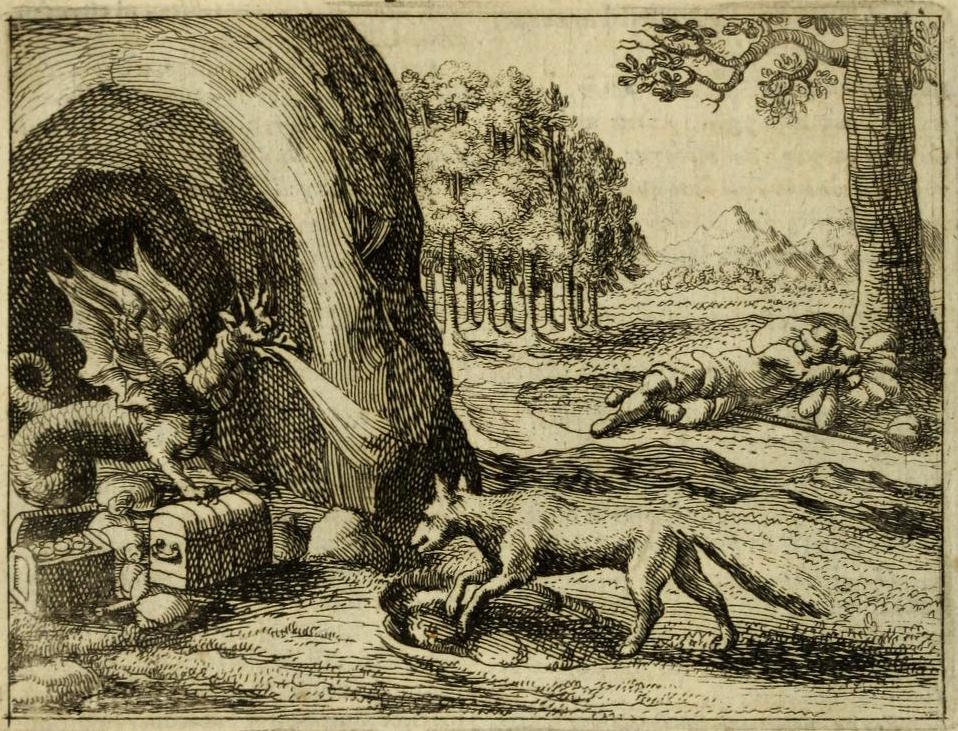
The Fox and the Dragon


4.14. THE FOX AND THE DRAGON.
A Fox was throwing up the soil,
And while with his assiduous toil
He burrow’d deep into the ground,
A Dragon in his den he found,
A-watching hidden treasure there,
Whom seeing, Renard speaks him fair:
“First, for your pardon I apply
For breaking on your privacy;
Then, as you very plainly see
That gold is of no use to me,
Your gentle leave let me obtain
To ask you, what can be the gain
Of all this care, and what the fruit,
That you should not with sleep recruit
Your spirits, but your life consume
Thus in an everlasting gloom?”
“’Tis not my profit here to stay,”
He cries; “but I must Jove obey.”
“What! will you therefore nothing take
Yourself, nor others welcome make?”
“Ev’n so the fates decree:” —“Then, sir,
Have patience, whilst I do aver
That he who like affections knows
Is born with all the gods his foes.
Since to that place you needs must speed,
Where all your ancestors precede,
Why in the blindness of your heart
Do you torment your noble part?”
All this to thee do I indite,
Thou grudging churl, thy heir’s delight,
Who robb’st the gods of incense due,
Thyself of food and raiment too;
Who hear’st the harp with sullen mien,
To whom the piper gives the spleen;
Who’rt full of heavy groans and sighs
When in their price provisions rise;
Who with thy frauds heaven’s patience tire
To make thy heap a little higher,
And, lest death thank thee, in thy will
Hast tax’d the undertaker’s bill. [more info]

The Man and the Adder


4.13. THE MAN AND THE ADDER.
He, that malicious men relieves,
His folly in a season grieves.
A Man, against himself humane,
Took up an Adder, that had lain
And stiffen’d in the frosty air,
And in his bosom placed with care,
Where she with speed recov’ring breath,
Her benefactor stung to death.
Another Adder near the place,
On asking why she was so base,
Was told, “’Tis others to dissuade
From giving wickedness their aid.” [more info]

The Pilot and Sailors


4.12. THE PILOT AND SAILORS.
On hearing a poor man lament
His worldly thoughts in discontent,
Esop this tale began to write,
For consolation and delight.
The ship by furious tempests toss’d,
The Mariners gave all for lost;
But midst their tears and dread, the scene
Is changed at once, and all serene.
The wind is fair, the vessel speeds,
The Sailors’ boist’rous joy exceeds:
The Pilot then, by peril wise,
Was prompted to philosophise.
“’Tis right to put a due restraint
On joy, and to retard complaint,
Because alternate hope and fright
Make up our lives of black and white.” [more info]

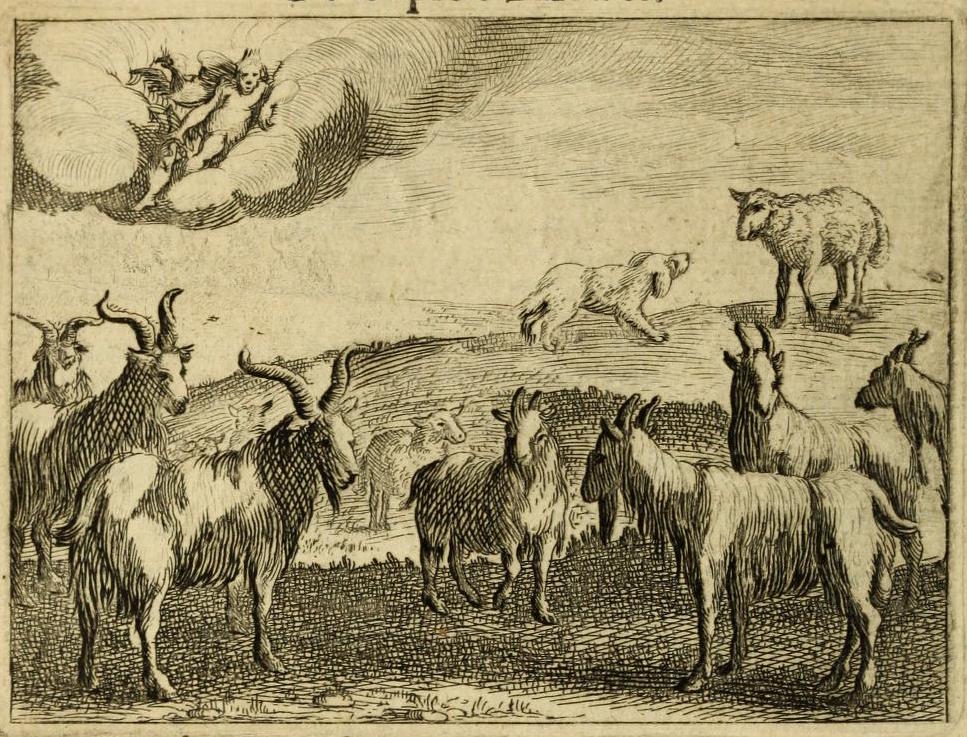
The He-Goats and She-Goats


4.11. THE HE-GOATS AND SHE-GOATS.
When the She-Goats from Jove obtain’d
A beard, th’ indignant Males complain’d,
That females by this near approach
Would on their gravity encroach.
“Suffer, my sapient friends,” says he,
“Their eminence in this degree,
And bear their beard’s most graceful length,
As they can never have your strength.”
Warn’d by this little tale, agree
With men in gen’ral form’d like thee,
While you by virtue still exceed,
And in the spirit take the lead. [more info]

Hercules and Plutus


4.10. HERCULES AND PLUTUS.
Wealth by the brave is justly scorn’d,
Since men are from the truth suborn’d,
And a full chest perverts their ways
From giving or deserving praise.
When Hercules, for matchless worth,
Was taken up to heav’n from earth,
As in their turns to all the crowd
Of gratulating gods he bow’d,
When Plutus, Fortune’s son, he spies,
He from his face averts his eyes.
Jove ask’d the cause of this disgust:
“I hate him, as he is unjust,
To wicked men the most inclined,
And grand corrupter of mankind.” [more info]