Showing posts with label index: Perry 521. Show all posts

The Ant and the Fly

2.17. De formica et musca
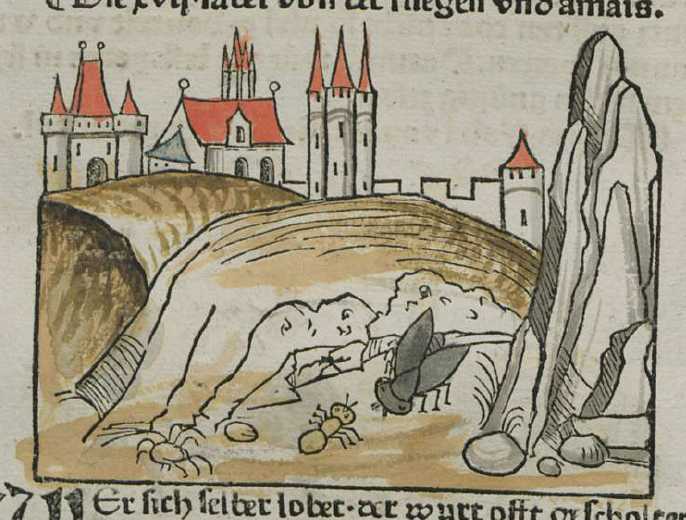
Caxton: Of the ante and of the flye
To make boost and auauntynge is but vayne glorye and folye / wherof Esope recyteth suche a fable / Of the ante of formyce and of the flye / whiche stryued to gyder / for to wete whiche was the most noble of them bothe / & the flye sayd to the formyce / Come hyder formyce / wylt thow compare thy self to me that dwelle in the kynges places and palays / and ete and drynke at theyr table / And also I kysse bothe kynge and qeune / and the most fayre maydens / And thow poure and myschaunt beest thow arte euer within the erthe / And thenne the formyce ansuerd to the flye / Now knowe I wel thy vanyte and folye / For thow auauntest the of that wherof thow sholdest disprayse the / For fro alle places where as thow goost or flyest / thow arte hated chaced and put oute / and lyuest in grete daunger / for assone as the wynter shalle come thow shalt deye / And I shal abyde on lyue alone within my chambre or hole / where as I drynke and ete at my playsyr / For the wynter shalle not forgyue to the thy mysdede / but he shalle slee the /
And thus he that wylle mocque or dispreyse somme other / he ought fyrst to loke and behold on hym self wel / For men sayn comynly / who that beholdeth in the glas / wel he seeth hym self / And who seeth hym self / wel he knoweth hym self / And who that knoweth hym self wel / lytel he preyseth hym self / And who that preyseth hym self lytyll / he is ful wyse and sage
[more info]

The Ant and the Fly


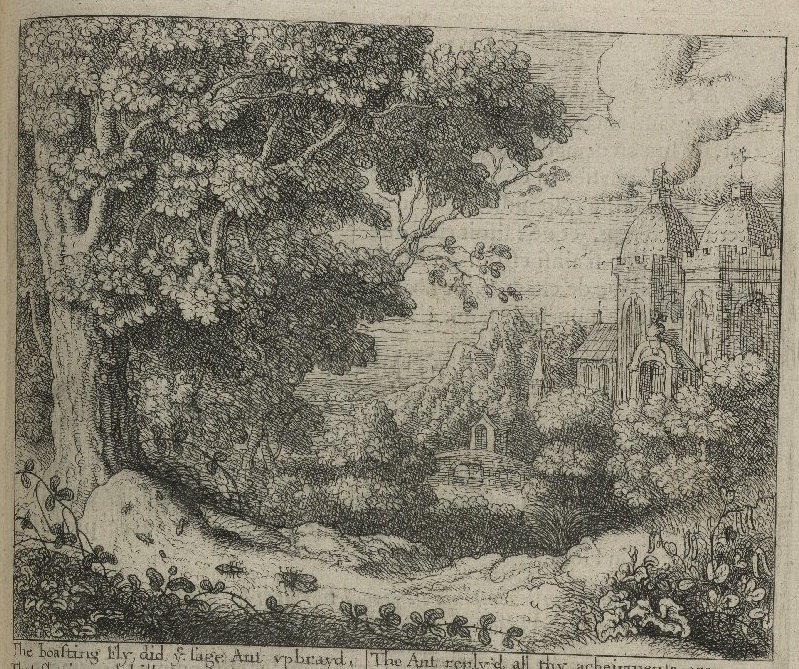
4.23. THE ANT AND THE FLY. An Ant and a Fly were contending with great warmth which was of the greater importance. The Fly was the first to begin: “Can you possibly compare with my endowments? When a sacrifice is made, I am the first to taste of the entrails that belong to the Gods. I pass my time among the altars, I wander through all the temples; soon as I have espied it, I seat myself on the head of a king; and I taste of the chaste kisses of matrons. I labour not, and yet enjoy the nicest of things: what like to this, good rustic, falls to your lot?”
“Eating with the Gods,” said the Ant, “is certainly a thing to be boasted of; but by him who is invited, not him who is loathed as an intruder. You talk about kings and the kisses of matrons. While I am carefully heaping up a stock of grain for winter, I see you feeding on filth about the walls. You frequent the altars; yes, and are driven away as often as you come. You labour not; therefore it is that you have nothing when you stand in need of it. And, further, you boast about what modesty ought to conceal. You tease me in summer; when winter comes you are silent. While the cold is shrivelling you up and putting you to death, a well-stored abode harbours me. Surely I have now pulled down your pride enough.”
A Fable of this nature distinctly points out the characters of those who set themselves off with unfounded praises, and of those whose virtues gain solid fame. [more info]

The Ant and the Fly


027. THE ANT AND THE FLY. One day there happened some words between the ant and the fly about precedency, and the point was argued with great warmth and eagerness on both sides. Says the fly, “It is well known what my pretensions are, and how justly grounded. There is never a sacrifice that is offered, but I always taste of the entrails even before the gods themselves. I have one of the uppermost seats at church, and frequent the altar as often as anybody. I have a free admission at court, and can never want the king's ear, for I sometimes sit upon his shoulder. There is not a maid of honour, or handsome young creature comes in my way, but if I like her, I settle between her balmy lips. And then I eat and drink the best of everything, without having any occasion to work for my living. What is there that such country pusses as you enjoy, to be compared to a life like this?”
The ant, who by this time had composed herself, replied, with a great deal of temper, and no less severity: “Indeed, to be a guest at the entertainment of the gods is a very great honour, if one is invited, but I should not care to be a disagreeable intruder anywhere. You talk of the king and the court, and the fine ladies there, with great familiarity; but as I have been getting in my harvest, in summer, I have seen a certain person, under the town walls, making a hearty meal upon something that is not so proper to be mentioned. As to your frequenting the altars, you are in the right to take sanctuary where you are like to meet with the least disturbance; but I have known people before now run to altars, and call it devotion, when they have been shut out of all good company, and had nowhere else to go. You don’t work for your living, you say: true—therefore when you have played away the summer, and winter comes, you have nothing to live upon: and while you are starving with cold and hunger, I have a good warm house over my head, and plenty of provisions about me.” [more info]

The Ant and the Fly


4.17. THE ANT AND THE FLY.
An Ant and Fly had sharp dispute
Which creature was of most repute;
When thus began the flaunting Fly:
“Are you so laudible as I?
I, ere the sacrifice is carved,
Precede the gods; first come, first served—
Before the altar take my place,
And in all temples show my face,
Whene’er I please I set me down
Upon the head that wears a crown.
I with impunity can taste
The kiss of matrons fair and chaste.
And pleasure without labor claim—
Say, trollop, canst thou do the same?”
“The feasts of gods are glorious fare.
No doubt, to those who’re welcome there;
But not for such detested things.—
You talk of matron’s lips and kings;
I, who with wakeful care and pains
Against the winter hoard my grains,
Thee feeding upon ordure view.—
The altars you frequent, ’tis true;
But still are driv’n away from thence,
And elsewhere, as of much offence.
A life of toil you will not lead,
And so have nothing when you need.
Besides all this, you talk with pride
Of things that modesty should hide.
You plague me here, while days increase,
But when the winter comes you cease.
Me, when the cold thy life bereaves,
A plenteous magazine receives.
I think I need no more advance
To cure you of your arrogance.”
The tenor of this tale infers
Two very diff’rent characters;
Of men self-praised and falsely vain,
And men of real worth in grain. [more info]

The Ant and the Fly


048. THE ANT AND THE FLY. One day there happened some words between the ant and the fly about precedency, and the point was argued with great warmth and eagerness on both sides. Says the fly, “It is well known what my pretensions are, and how justly grounded. There is never a sacrifice that is offered, but I always taste of the entrails even before the gods themselves. I have one of the uppermost seats at church, and frequent the altar as often as anybody. I have a free admission at court, and can never want the king's ear, for I sometimes sit upon his shoulder. There is not a maid of honour, or handsome young creature comes in my way, but if I like her, I settle between her balmy lips. And then I eat and drink the best of everything, without having any occasion to work for my living. What is there that such country pusses as you enjoy, to be compared to a life like this?”
The ant, who by this time had composed herself, replied, with a great deal of temper, and no less severity: “Indeed, to be a guest at the entertainment of the gods is a very great honour, if one is invited, but I should not care to be a disagreeable intruder anywhere. You talk of the king and the court, and the fine ladies there, with great familiarity; but as I have been getting in my harvest, in summer, I have seen a certain person, under the town walls, making a hearty meal upon something that is not so proper to be mentioned. As to your frequenting the altars, you are in the right to take sanctuary where you are like to meet with the least disturbance; but I have known people before now run to altars, and call it devotion, when they have been shut out of all good company, and had nowhere else to go. You don’t work for your living, you say: true—therefore when you have played away the summer, and winter comes, you have nothing to live upon: and while you are starving with cold and hunger, I have a good warm house over my head, and plenty of provisions about me.” [more info]

An Ant and Fly


2.06. AN ANT AND FLY. "Where's the honour or the pleasure in the world," says the Fly, in a dispute for preeminence with the Ant, "that I have not my part in? Are not all temples and places open to me? Am not I the taster to gods and princes in all their sacrifices and entertainments? And all this without either money or pains? I trample upon crowns, and kiss what ladies' lips I please. And what have you now to pretend to all this while?"
"Vain boaster!" says the Ant, "dost thou not know the difference between the access of a guest and that of an intruder? for people are so far from liking your company, that they kill you as soon as they catch you. You are a plague to them wherever you come. Your very breath has maggots in it; and for the kiss you brag of, what is it but the perfume of the last dunghill you touched upon, once removed? For my part, I live upon what's my own, and work honestly in the summer to maintain myself in the winter; whereas the whole course of your scandalous life is only cheating or sharping one half of the year, and starving the other."
MORAL. The happiness of life does not lie so much in enjoying small advantages, as in living free from great inconveniences. An honest mediocrity is the happiest state a man can wish for. [more info]

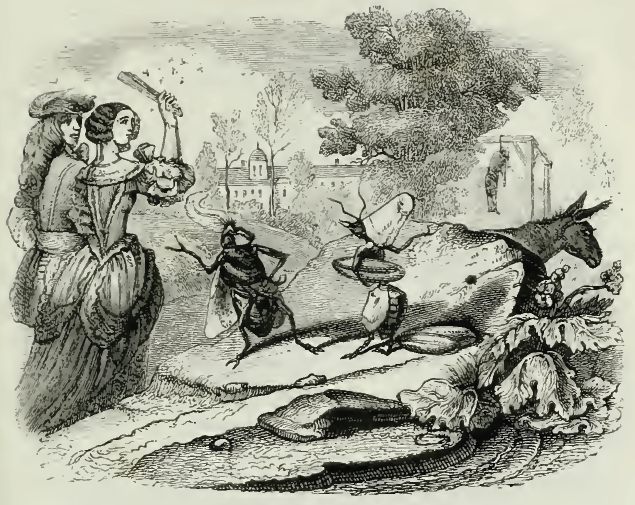
The Fly and the Ant


04.03: THE FLY AND THE ANT.
A fly and ant, upon a sunny bank,
Discuss'd the question of their rank.
'O Jupiter!' the former said,
'Can love of self so turn the head,
That one so mean and crawling,
And of so low a calling,
To boast equality shall dare
With me, the daughter of the air?
In palaces I am a guest,
And even at thy glorious feast.
Whene'er the people that adore thee
May immolate for thee a bullock,
I'm sure to taste the meat before thee.
Meanwhile this starveling, in her hillock,
Is living on some bit of straw
Which she has labour'd home to draw.
But tell me now, my little thing,
Do you camp ever on a king,
An emperor, or lady?
I do, and have full many a play-day
On fairest bosom of the fair,
And sport myself upon her hair.
Come now, my hearty, rack your brain
To make a case about your grain.'
'Well, have you done?' replied the ant.
'You enter palaces, I grant,
And for it get right soundly cursed.
Of sacrifices, rich and fat,
Your taste, quite likely, is the first;—
Are they the better off for that?
You enter with the holy train;
So enters many a wretch profane.
On heads of kings and asses you may squat;
Deny your vaunting I will not;
But well such impudence, I know,
Provokes a sometimes fatal blow.
The name in which your vanity delights
Is own'd as well by parasites,
And spies that die by ropes—as you soon will
By famine or by ague-chill,
When Phoebus goes to cheer
The other hemisphere,—
The very time to me most dear.
Not forced abroad to go
Through wind, and rain, and snow,
My summer's work I then enjoy,
And happily my mind employ,
From care by care exempted.
By which this truth I leave to you,
That by two sorts of glory we are tempted,
The false one and the true.
Work waits, time flies; adieu:—
This gabble does not fill
My granary or till.'
[more info]