Showing posts with label book: 1701 Phaedrus. Show all posts

Hoogstratanus's Phaedrus, 1701

Phaedri Fabularum Aesopiarum libri V = The Five Books of Phaedrus's Aesopic Fables, edited by David Hoogstratanus with illustrations, published in 1701.

online source: Internet Archive

This book is in Latin, so for the text I have used Henry Thomas Riley's prose translation of Phaedrus, which you can find at Project Gutenberg.

Here's a random image from the book:


1.01. THE WOLF AND THE LAMB.
1.02. THE FROGS ASKING FOR A KING.


Here's a random fable from the book:


The Man and the Trees


6.05. THE MAN AND THE TREES. Those perish, who give assistance to their foes.
A certain Man, having made an axe, besought the Trees to afford him a handle from their wood that would prove firm: they all desired that a piece of Olive-tree should be given. He accepted the offer, and, fitting on the handle, set to work with the axe to hew down the huge trunks. While he was selecting such as he thought fit, the Oak is reported thus to have said to the Ash: “We richly deserve to be cut down.” [more info]

The Lion and the Mouse


6.04. THE LION AND THE MOUSE. This Fable teaches that no one should hurt those of more humble condition.
While a Lion was asleep in a wood, where some Field-Mice were sporting about, one of them by chance leaped upon the Lion as he lay. The Lion awoke and seized the wretched creature with a sudden spring. The captive implored pardon and suppliantly confessed his crime, a sin of imprudence. The Monarch, not deeming it a glorious thing to exact vengeance for this, pardoned him and let him go. A few days after, the Lion, while roaming by night, fell into a trap. When he perceived that he was caught in the snare, he began to roar with his loudest voice. At this tremendous noise the Mouse instantly ran to his assistance, and exclaimed: “You have no need to fear; I will make an adequate return for your great kindness.” Immediately he began to survey all the knots and the fastenings of the knots; and gnawing the strings after he had examined them, loosened the snare. Thus did the Mouse restore the captured Lion to the woods. [more info]

Jupiter and the Fox


6.03. JUPITER AND THE FOX. No fortune conceals baseness of nature.
Jupiter having changed a Fox into a human shape, while she was sitting as a Mistress on a royal throne, she saw a beetle creeping out of a corner, and sprang nimbly towards the well-known prey. The Gods of heaven smiled; the Great Father was ashamed, and expelled the Concubine, repudiated and disgraced, addressing her in these words: “Live on in the manner that you deserve, you, who cannot make a worthy use of my kindness.” [more info]

The Hares Tired of Life


6.02. THE HARES TIRED OF LIFE. He who cannot endure his own misfortune, let him look at others, and learn patience.
On one occasion, the Hares being scared in the woods by a great noise, cried out, that, on account of their continued alarms, they would end their lives. So they repaired to a certain pond, into which, in their despondency, they were going to throw themselves. Alarmed at their approach, some Frogs fled distractedly into the green sedge. “Oh!” says one of the hares, “there are others too whom fear of misfortune torments. Endure existence as others do.” [more info]

The Sick Kite


6.01. THE SICK KITE. A Kite having been sick for many months, and seeing now there was no longer any hope of his recovery, asked his Mother to go round the sacred places, and make the most earnest vows for his recovery. “I will do so, my Son,” said she, “but I am greatly afraid I shall obtain no help; but you, who have polluted every temple and every altar with your ravages, sparing no sacrificial food, what is it you would now have me ask?” [more info]

The Huntsman and the Dog


5.10. THE HUNTSMAN AND THE DOG. A Dog, who had always given satisfaction to his master by his boldness against swift and savage beasts, began to grow feeble under increasing years. On one occasion, being urged to the combat with a bristling Boar, he seized him by the ear; but, through the rottenness of his teeth, let go his prey. Vexed at this, the Huntsman upbraided the Dog. Old Barker replied: “It is not my courage that disappoints you, but my strength. You commend me for what I have been; and you blame me that I am not what I was.”
You, Philetus, may easily perceive why I have written this. [more info]

The Bull and the Calf


5.09. THE BULL AND THE CALF. When a Bull was struggling with his horns in a narrow passage, and could hardly effect an entrance to the manger, a Calf began to point out in what way he might turn himself: “Hush,” said the Bull, “I knew that before you were born.”
Let him who would instruct a wiser man, consider this as said to himself. [more info]

The Emblem of Opportunity


5.08. THE EMBLEM OF OPPORTUNITY. A Bald Man, balancing on a razor’s edge, fleet of foot, his forehead covered with hair, his body naked—if you have caught him, hold him fast; when he has once escaped, not Jupiter himself can overtake him: he is the emblem how short-lived is Opportunity.
The ancients devised such a portraiture of Time, to signify that slothful delay should not hinder the execution of our purposes. [more info]

Princeps, The Flute-Player


5.07. PRINCEPS, THE FLUTE-PLAYER. When a weak mind, beguiled by frivolous applause, has once given way to insolent self-sufficiency, such foolish vanity is easily exposed to ridicule.
Princeps, the Flute-player, was pretty well known, being accustomed to accompany Bathyllus with his music on the stage. It chanced that, at a representation, I don’t well remember what it was, while the flying-machine was being whirled along, he fell heavily, through inadvertence, and broke his left leg, when he would much rather have parted with two right ones. He was picked up and carried to his house groaning aloud. Some months pass by before his cure is completed. As is the way with the spectators, for they are a merry race, the man began to be missed, by whose blasts the vigour of the dancer was wont to be kept at full stretch.
A certain Nobleman was about to exhibit a show, just when Princeps was beginning to walk abroad. With a present and entreaties he prevailed upon him merely to present himself on the day of the show. When the day came a rumour about the Flute-player ran through the theatre. Some affirmed that he was dead, some that he would appear before them without delay. The curtain falling, the thunders rolled, and the Gods conversed in the usual form.
At this moment the Chorus struck up a song unknown to him who had so recently returned; of which the burthen was this: “Rejoice, Rome, in security, for your prince [Princeps] is well.” All rise with one consent and applaud. The Flute-player kisses hands, and imagines that his friends are congratulating him. The Equestrian order perceive the ridiculous mistake, and with loud laughter encore the song. It is repeated. My man now throws himself sprawling at full length upon the stage. Ridiculing him, the Knights applaud; while the people fancy he is only asking for a chaplet. When, however, the reality came to be known throughout all the tiers,
Princeps, his leg bound up with a snow-white fillet, clad in snow-white tunic, and snow-white shoes, while pluming himself on the honors really paid to the Deified House, was thrust out headlong by common consent. [more info]

The Two Bald Men


5.06. THE TWO BALD MEN. A Bald Man chanced to find a comb in the public road. Another, equally destitute of hair, came up: “Come,” said he, “shares, whatever it is you have found.” The other showed the booty, and added withal: “The will of the Gods has favoured us, but through the malignity of fate, we have found, as the saying is, a coal instead of a treasure.”
This complaint befits him whom hope has disappointed. [more info]

The Buffoon and the Countryman


5.05. THE BUFFOON AND THE COUNTRYMAN. Men are in the habit of erring through prejudice; and while they stand up in defence of their erroneous notions, are wont to be driven by plain facts to confession of their mistakes.
A rich Man, about to entertain the people with grand shows, invited all, by the promise of a reward, to exhibit whatever new piece of ingenuity any one could. The Performers came to the contest for fame, among whom a Buffoon, well known for his drollery, said that he had a kind of entertainment which had never yet been brought out at any theatre. The rumour, spreading, brought together the whole city; and the places, empty shortly before, sufficed not for the multitude. But as soon as he appeared on the stage, alone, and without any apparatus, any stage-assistants, the very intenseness of expectation produced silence. Suddenly, he dropped down his head towards his bosom, and so well did he imitate the voice of a pig with his own, that they concluded there was a real one under his cloak, and ordered it to be shaken out. This being done, as soon as they found that nothing was discovered, they loaded the Man with many praises, and bestowed upon him the greatest applause.
A Countryman seeing this take place: “Egad,” said he, “he shan’t surpass me;” and immediately gave out that he would do the same thing still better on the following day. A still greater crowd assembled. Prejudice had already taken possession of their minds, and they took their seats, determined to deride, and not as unbiased spectators. Both Performers come forth. First, the Buffoon grunts away, and excites their applause, and awakens their acclamations. Next, the Countryman, pretending that he concealed a pig beneath his clothes (which, in fact, he did; but quite unsuspected, because they had found none about the other), twitched the ear of the real pig, which he was concealing, and with the pain forced from it its natural cry.
The people shouted with one voice that the Buffoon had given a much more exact imitation, and ordered the Countryman to be driven from the stage. On this, he produced the pig itself from the folds of his cloak, and convicting them of their disgraceful mistake by a manifest proof: “Look,” said he, “this shows what sort of judges you are.” [more info]

The Man and the Ass


5.04. THE MAN AND THE ASS. A Man having sacrificed a young boar to the god Hercules, to whom he owed performance of a vow made for the preservation of his health, ordered the remains of the barley to be set for the Ass. But he refused to touch it, and said: “I would most willingly accept your food, if he who had been fed upon it had not had his throat cut.”
Warned by the significance of this Fable, I have always been careful to avoid the gain that exposed to hazard. “But,” say you, “those who have got riches by rapine, are still in possession of them.” Come, then, let us enumerate those, who, being detected, have come to a bad end; you will find that those so punished constitute a great majority. Rashness brings luck to a few, misfortune to most. [more info]

The Bald Man and the Fly


5.03. THE BALD MAN AND THE FLY. A Fly bit the bare pate of a Bald Man; who, endeavouring to crush it, gave himself a heavy blow. Then said the Fly jeeringly: “You wanted to revenge the sting of a tiny insect with death; what will you do to yourself, who have added insult to injury?” The Man made answer: “I am easily reconciled to myself, because I know that there was no intention of doing harm. But you, worthless insect, and one of a contemptible race, who take a delight in drinking human blood, I could wish to destroy you, even at a heavier penalty.”
This Fable teaches that pardon is to be granted to him who errs through mistake. But him who is designedly mischievous, I deem to be deserving of any punishment. [more info]

The Travelers and the Robber


5.02. THE TRAVELLERS AND THE ROBBER. Two Soldiers having fallen in with a Robber, one fled, while the other stood his ground, and defended himself with a stout right-hand. The Robber slain, his cowardly companion comes running up, and draws his sword; then throwing back his travelling cloak, says: “Let’s have him I’ll take care he shall soon know whom he attacks.” On this, he who had vanquished the robber made answer: “I wish you had seconded me just now at least with those words; I should have been still more emboldened, believing them true; now keep your sword quiet, as well as your silly tongue, that you may be able to deceive others who don’t know you. I, who have experienced with what speed you take to your heels, know full well that no dependence is to be placed upon your valour.”
This story may be applied to him who is courageous in prosperity, in times of danger takes to flight. [more info]

Demetrius and Menander


5.01. DEMETRIUS AND MENANDER. Demetrius, who was called Phalereus, unjustly took possession of the sovereignty of Athens. The mob, according to their usual practice, rush from all quarters vying with each other, and cheer him, and wish him joy. Even the chief men kiss the hand by which they are oppressed, while they silently lament the sad vicissitudes of fortune. Moreover, those who live in retirement, and take their ease, come creeping in last of all, that their absence may not injure them.
Among these Menander, famous for his Comedies (which Demetrius, who did not know him, had read, and had admired the genius of the man), perfumed with unguents, and clad in a flowing robe, came with a mincing and languid step.
As soon as the Tyrant caught sight of him at the end of the train: “What effeminate wretch,” said he, “is this, who presumes to come into my presence?”
Those near him made answer: “This is Menander the Poet.”
Changed in an instant, he exclaimed: “A more agreeable looking man could not possibly exist.” [more info]

Simonides Preserved by the Gods


4.24. SIMONIDES PRESERVED BY THE GODS. I have said, above, how greatly learning is esteemed among men: I will now hand down to posterity how great is the honor paid to it by the Gods.
Simonides, the very same of whom I have before made mention, agreed, at a fixed price, to write a panegyric for a certain Pugilist, who had been victorious: accordingly he sought retirement. As the meagreness of his subject cramped his imagination, he used, according to general custom, the license of the Poet, and introduced the twin stars of Leda, citing them as an example of similar honours. He finished the Poem according to contract, but received only a third part of the sum agreed upon. On his demanding the rest: “They,” said he, “will give it you whose praises occupy the other two-thirds; but, that I may feel convinced that you have not departed in anger, promise to dine with me, as I intend to-day to invite my kinsmen, in the number of whom I reckon you.”
Although defrauded, and smarting under the injury, in order that he might not, by parting on bad terms, break off all friendly intercourse, he promised that he would. At the hour named he returned, and took his place at table. The banquet shone joyously with its cups; the house resounded with gladness, amid vast preparations, when, on a sudden, two young men, covered with dust, and dripping with perspiration, their bodies of more than human form, requested one of the servants to call Simonides to them, and say that it was of consequence to him to make no delay. The man, quite confused, called forth Simonides; and hardly had he put one foot out of the banquetting room, when suddenly the fall of the ceiling crushed the rest, and no young men were to be seen at the gate.
When the circumstances of the story I have told were made known, all were persuaded that the personal intervention of the Divinities had saved the Poet’s life by way of reward. [more info]

The Ant and the Fly


4.23. THE ANT AND THE FLY. An Ant and a Fly were contending with great warmth which was of the greater importance. The Fly was the first to begin: “Can you possibly compare with my endowments? When a sacrifice is made, I am the first to taste of the entrails that belong to the Gods. I pass my time among the altars, I wander through all the temples; soon as I have espied it, I seat myself on the head of a king; and I taste of the chaste kisses of matrons. I labour not, and yet enjoy the nicest of things: what like to this, good rustic, falls to your lot?”
“Eating with the Gods,” said the Ant, “is certainly a thing to be boasted of; but by him who is invited, not him who is loathed as an intruder. You talk about kings and the kisses of matrons. While I am carefully heaping up a stock of grain for winter, I see you feeding on filth about the walls. You frequent the altars; yes, and are driven away as often as you come. You labour not; therefore it is that you have nothing when you stand in need of it. And, further, you boast about what modesty ought to conceal. You tease me in summer; when winter comes you are silent. While the cold is shrivelling you up and putting you to death, a well-stored abode harbours me. Surely I have now pulled down your pride enough.”
A Fable of this nature distinctly points out the characters of those who set themselves off with unfounded praises, and of those whose virtues gain solid fame. [more info]

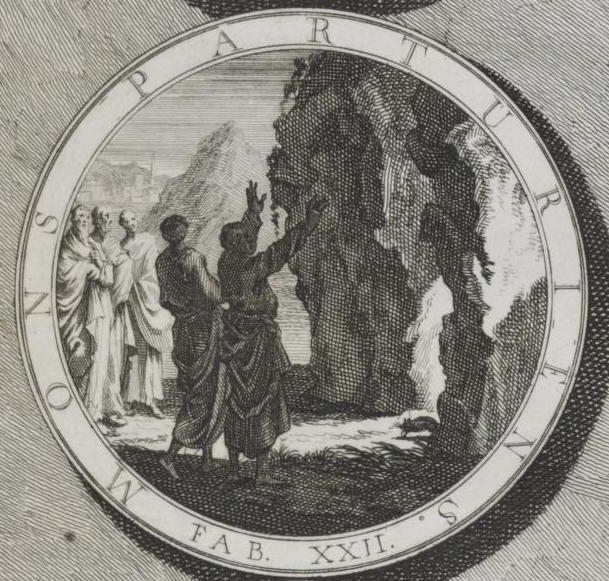
The Mountain in Labour


4.22. THE MOUNTAIN IN LABOUR. A Mountain was in labour, sending forth dreadful groans, and there was in the districts the highest expectation. After all, it brought forth a Mouse.
This is designed for you, who, when you have threatened great things, produce nothing. [more info]

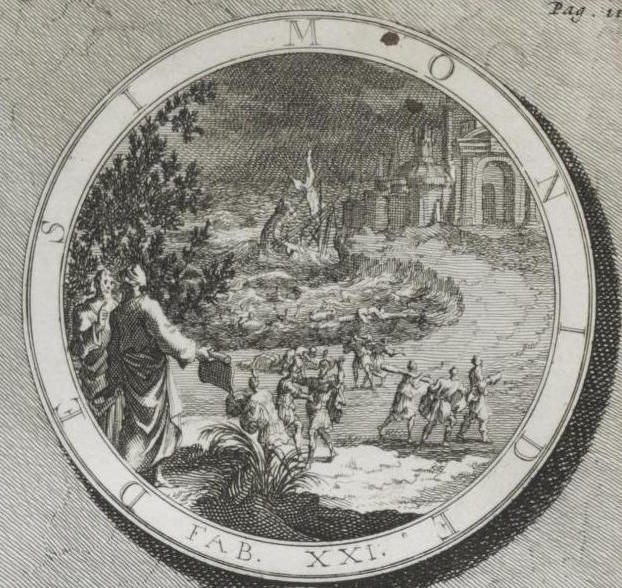
The Shipwreck of Simonides


4.21. THE SHIPWRECK OF SIMONIDES. A learned man has always a fund of riches in himself.
Simonides, who wrote such excellent lyric poems, the more easily to support his poverty, began to make a tour of the celebrated cities of Asia, singing the praises of victors for such reward as he might receive. After he had become enriched by this kind of gain, he resolved to return to his native land by sea; (for he was born, it is said, in the island of Ceos).
Accordingly he embarked in a ship, which a dreadful tempest, together with its own rottenness, caused to founder at sea. Some gathered together their girdles, others their precious effects, which formed the support of their existence. One who was overly inquisitive, remarked: “Are you going to save none of your property, Simonides?”
He made reply: “All my possessions are about me.”
A few only made their escape by swimming, for the majority, being weighed down by their burdens, perished. Some thieves make their appearance, and seize what each person has saved, leaving them naked. Clazomenæ, an ancient city, chanced to be near; to which the shipwrecked persons repaired.
Here a person devoted to the pursuits of literature, who had often read the lines of Simonides, and was a very great admirer of him though he had never seen him, knowing from his very language who he was, received him with the greatest pleasure into his house, and furnished him with clothes, money, and attendants. The others meanwhile were carrying about their pictures, begging for victuals. Simonides chanced to meet them; and, as soon as he saw them, remarked: “I told you that all my property was about me; what you endeavoured to save is lost.” [more info]