Showing posts with label index: Perry 325. Show all posts

The Lark's Nest in the Corn


006. THE LARK'S NEST IN THE CORN.
A Larke in standing corne had hatcht a brood
Which shee imployes when they persu'd theyr foode,
To gayne advisos when the full ear'd heape
The Sickle should as its due victime reape
When trembling they told her the ensuing morne.
The neighbours joyne to fell the owners corne.
Feare not said shee those will not yett approach.
Then a wilde noyse, his friends will come they broach,
Dread not says shee the incursions of his friends,
The owner lastly they assert, intends,
Ioyn'd with his sonne, next morne to reape the feild.
Nay then 'tis time sayd shee our nest to yeild.
Moral
Neighbours and friends are backwards, who intends
T'effect things well must make his hands his friends.
[more info]

The Lark and her Young Ones


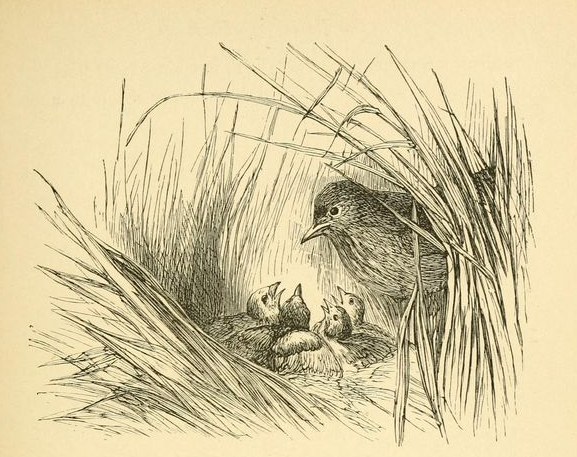
118. THE LARK AND HER YOUNG ONES. There was a brood of young Larks in a field of corn, which was just ripe, and the mother, looking every day for the reapers, left word, whenever she went out in search of food, that her young ones should report to her all the news they heard.
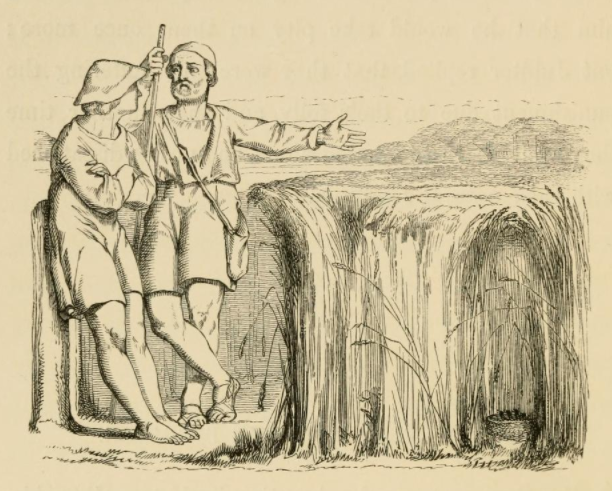
One day, while she was absent, the master came to look at the state of the crop. “It is full time,” said he, “to call in all my neighbours and get my corn reaped.”
When the old Lark came home, the young ones told their mother what they had heard, and begged her to remove them forthwith. “Time enough,” said she; “if he trusts to his neighbours, he will have to wait awhile yet for his harvest.”
Next day, however, the owner came again, and finding the sun still hotter and the corn more ripe, and nothing done, “There is not a moment to be lost,” said he; “we cannot depend upon our neighbours: we must call in our relations;” and, turning to his son, “Go call your uncles and cousins, and see that they begin to-morrow.”
In still greater fear, the young ones repeated to their mother the farmer’s words. “If that be all,” says she, “do not be frightened, for the relations have got harvest work of their own; but take particular notice what you hear the next time, and be sure you let me know.”
She went abroad the next day, and the owner coming as before, and finding the grain falling to the ground from over-ripeness, and still no one at work, called to his son. “We must wait for our neighbours and friends no longer; do you go and hire some reapers tonight, and we will set to work ourselves to-morrow.”
When the young ones told their mother this, “Then,” said she, “it is time to be off, indeed; for when a man takes up his business himself, instead of leaving it to others, you may be sure that he means to set to work in earnest.” [more info]

The Lark and her Young Ones


038. THE LARK AND HER YOUNG ONES. A lark, who had young ones in a field of corn which was almost ripe, was under some fear lest the reapers should come to reap it before her young brood were fledged, and able to remove from the place; wherefore, upon flying abroad to look for food, she left this charge with them, that they should take notice what they heard talked of in her absence, and tell her of it when she came back again.
When she was gone, they heard the owner of the corn call to his son: “Well,” says he, “I think this corn is ripe enough: I would have you go early to-morrow, and desire our friends and neighbours to come and help us to reap it.” When the old lark came home, the young ones fell a quivering and chirping round her, and told her what had happened, begging her to remove them as fast as she could. The mother bid them be easy, “for,” says she, “if the owner depends upon friends and neighbours, I am pretty sure the corn will not be reaped to-morrow.”
Next day she went out again upon the same occasion, and left the same orders with them as before. The owner came and stayed, expecting those he had sent to; but the sun grew hot, and nothing was done, for not a soul came to help him. “Then,” says he to his son, “I perceive these friends of ours are not to be depended upon, so that you must even go to your uncles and cousins, and tell them I desire they would be here betimes to-morrow morning, to help us to reap.”
Well, this the young ones, in a great fright reported also to their mother. “If that be all,” says she, “do not be frightened, children; for kindred and relations do not use to be so very forward to serve one another; but take particular notice what you hear the next time, and be sure to let me know it.”
She went abroad the next day, as usual; and the owner, finding his relations as slack as the rest of his neighbours, said to his son. “Harkye, George, do you get a couple of good sickles ready against to-morrow morning, and we will even reap the corn ourselves.”
When the young ones told their mother this, “Then,” says she, “we must be gone indeed; for when a man undertakes to do his business himself, it is not so likely he will be disappointed.” So she removed her young ones immediately, and the corn was reaped the next day by the good man and his son. [more info]

The Lark and the Cornfield


03. THE LARK AND THE CORNFIELD. A family of larks lived in a ripe cornfield. The mother knew that, when the reapers came, her nest would be spoiled, so she ordered the young ones to watch well, and to tell her of everything that happened while she was away.
One day, on returning home, she found the little larks very frightened. "The farmer has passed," they screamed, "and he is going to call in the neighbours to reap the field!"
"That is well," said the mother. "If he trusts to his neighbours, there is no need to fear."
The next day the fanner came again. "Call your uncles and cousins," he said to his son, "and with their help we shall begin to-morrow."
When the little larks, more frightened than ever, told their mother this, she answered, "We need not fear yet; his relations are busy cutting their own com."
But a few days afterwards, when the mother lark heard that the farmer had passed again, saying, "We shall ourselves reap the field to-morrow," she cried, "Now we must go! When a man says that he will do his work himself, it is sure to be done." [more info]

The Lark and her Young Ones


006. THE LARK AND HER YOUNG ONES. A lark, who had young ones in a field of corn which was almost ripe, was under some fear lest the reapers should come to reap it before her young brood were fledged, and able to remove from the place; wherefore, upon flying abroad to look for food, she left this charge with them, that they should take notice what they heard talked of in her absence, and tell her of it when she came back again.
When she was gone, they heard the owner of the corn call to his son: “Well,” says he, “I think this corn is ripe enough: I would have you go early to-morrow, and desire our friends and neighbours to come and help us to reap it.” When the old lark came home, the young ones fell a quivering and chirping round her, and told her what had happened, begging her to remove them as fast as she could. The mother bid them be easy, “for,” says she, “if the owner depends upon friends and neighbours, I am pretty sure the corn will not be reaped to-morrow.”
Next day she went out again upon the same occasion, and left the same orders with them as before. The owner came and stayed, expecting those he had sent to; but the sun grew hot, and nothing was done, for not a soul came to help him. “Then,” says he to his son, “I perceive these friends of ours are not to be depended upon, so that you must even go to your uncles and cousins, and tell them I desire they would be here betimes to-morrow morning, to help us to reap.”
Well, this the young ones, in a great fright reported also to their mother. “If that be all,” says she, “do not be frightened, children; for kindred and relations do not use to be so very forward to serve one another; but take particular notice what you hear the next time, and be sure to let me know it.”
She went abroad the next day, as usual; and the owner, finding his relations as slack as the rest of his neighbours, said to his son. “Harkye, George, do you get a couple of good sickles ready against to-morrow morning, and we will even reap the corn ourselves.”
When the young ones told their mother this, “Then,” says she, “we must be gone indeed; for when a man undertakes to do his business himself, it is not so likely he will be disappointed.” So she removed her young ones immediately, and the corn was reaped the next day by the good man and his son. [more info]

The Lark and her Young Ones


213. THE LARK AND HER YOUNG ONES. A LARK had made her nest in the early spring on the young green wheat. The brood had almost grown to their full strength and attained the use of their wings and the full plumage of their feathers, when the owner of the field, looking over his ripe crop, said, “The time has come when I must ask all my neighbors to help me with my harvest.” One of the young Larks heard his speech and related it to his mother, inquiring of her to what place they should move for safety. “There is no occasion to move yet, my son,” she replied; “the man who only sends to his friends to help him with his harvest is not really in earnest.” The owner of the field came again a few days later and saw the wheat shedding the grain from excess of ripeness. He said, “I will come myself tomorrow with my laborers, and with as many reapers as I can hire, and will get in the harvest.” The Lark on hearing these words said to her brood, “It is time now to be off, my little ones, for the man is in earnest this time; he no longer trusts his friends, but will reap the field himself.”
Self-help is the best help. [more info]

The Lark and her Young Ones


04.22: THE LARK AND HER YOUNG ONES WITH THE OWNER OF A FIELD.
"Depend upon yourself alone,"
Has to a common proverb grown.
'Tis thus confirm'd in Aesop's way:—
The larks to build their nests are seen
Among the wheat-crops young and green;
That is to say,
What time all things, dame Nature heeding,
Betake themselves to love and breeding—
The monstrous whales and sharks,
Beneath the briny flood,
The tigers in the wood,
And in the fields, the larks.
One she, however, of these last,
Found more than half the spring-time past
Without the taste of spring-time pleasures;
When firmly she set up her will
That she would be a mother still,
And resolutely took her measures;—
First, got herself by Hymen match'd;
Then built her nest, laid, sat, and hatch'd.
All went as well as such things could.
The wheat-crop ripening ere the brood
Were strong enough to take their flight,
Aware how perilous their plight,
The lark went out to search for food,
And told her young to listen well,
And keep a constant sentinel.
'The owner of this field,' said she,
'Will come, I know, his grain to see.
Hear all he says; we little birds
Must shape our conduct by his words.'
No sooner was the lark away,
Than came the owner with his son.
'This wheat is ripe,' said he: 'now run
And give our friends a call
To bring their sickles all,
And help us, great and small,
To-morrow, at the break of day.'
The lark, returning, found no harm,
Except her nest in wild alarm.
Says one, 'We heard the owner say,
Go, give our friends a call
To help, to-morrow, break of day.'
Replied the lark, 'If that is all,
We need not be in any fear,
But only keep an open ear.
As gay as larks, now eat your victuals.—'
They ate and slept—the great and littles.
The dawn arrives, but not the friends;
The lark soars up, the owner wends
His usual round to view his land.
'This grain,' says he, 'ought not to stand.
Our friends do wrong; and so does he
Who trusts that friends will friendly be.
My son, go call our kith and kin
To help us get our harvest in.'
This second order made
The little larks still more afraid.
'He sent for kindred, mother, by his son;
The work will now, indeed, be done.'
'No, darlings; go to sleep;
Our lowly nest we'll keep.'
With reason said; for kindred there came none.
Thus, tired of expectation vain,
Once more the owner view'd his grain.
'My son,' said he, 'we're surely fools
To wait for other people's tools;
As if one might, for love or pelf,
Have friends more faithful than himself!
Engrave this lesson deep, my son.
And know you now what must be done?
We must ourselves our sickles bring,
And, while the larks their matins sing,
Begin the work; and, on this plan,
Get in our harvest as we can.'
This plan the lark no sooner knew,
Than, 'Now's the time,' she said, 'my chicks;'
And, taking little time to fix,
Away they flew;
All fluttering, soaring, often grounding,
Decamp'd without a trumpet sounding.
[more info]

The Lark and her Young Ones


31. THE LARK AND HER YOUNG ONES. There was a brood of young Larks in a field of corn, which was just ripe. The mother, looking every day for the reapers, left word, whenever she went out in search of food, that her young ones should tell her all the news they heard.
One day, when she was absent, the master came to look at his field. "It is time," said he, "to call in my neighbors and get my corn reaped." When the old Lark came home, the young ones told their mother what they had heard, and begged her to move them at once.
"Time enough," said she. "If he trusts to his neighbors, he will have to wait awhile yet for his harvest."
Next day, the owner came again, and found the sun hotter, the corn riper, and nothing done.
"There is not an hour to be lost," said he. "We cannot depend upon our neighbors. We must call in our relations." Turning to his son, he said, "Go, call your uncles and cousins; and see that they begin to-morrow."
The young Larks, in great fear, told their mother what the farmer had said. "If that be all," said she, "do not be frightened. The relations have harvest work of their own. But take notice of what you hear next time, and be sure to let me know."
She went abroad the next day, and the owner coming, and finding the grain falling to the ground because it was over ripe, said to his son, "We must wait no longer for our neighbors and friends. Do you go to-night and hire some reapers, and we will set to work ourselves to-morrow."
When the young Larks told their mother this, "Then," said she, "it is time for us to be off. When a man takes up his business himself, instead of leaving it to others, you may be sure that he means to set to work in earnest." [more info]

The Lark and her Young Ones


127. THE LARK AND HER YOUNG ONES. A Lark made her nest in a field of young wheat. As the days passed, the wheat stalks grew tall and the young birds, too, grew in strength. Then one day, when the ripe golden grain waved in the breeze, the Farmer and his son came into the field.
"This wheat is now ready for reaping," said the Farmer. "We must call in our neighbors and friends to help us harvest it."
The young Larks in their nest close by were much frightened, for they knew they would be in great danger if they did not leave the nest before the reapers came. When the Mother Lark returned with food for them, they told her what they had heard.
"Do not be frightened, children," said the Mother Lark. "If the Farmer said he would call in his neighbors and friends to help him do his work, this wheat will not be reaped for a while yet."
A few days later, the wheat was so ripe, that when the wind shook the stalks, a hail of wheat grains came rustling down on the young Larks' heads.
"If this wheat is not harvested at once," said the Farmer, "we shall lose half the crop. We cannot wait any longer for help from our friends. Tomorrow we must set to work, ourselves."
When the young Larks told their mother what they had heard that day, she said:
"Then we must be off at once. When a man decides to do his own work and not depend on any one else, then you may be sure there will be no more delay."
There was much fluttering and trying out of wings that afternoon, and at sunrise next day, when the Farmer and his son cut down the grain, they found an empty nest.
Self-help is the best help. [more info]