4.05. ÆSOP INTERPRETING A WILL. I will show to posterity, by a short story, that there is often more merit in one man than in a multitude.
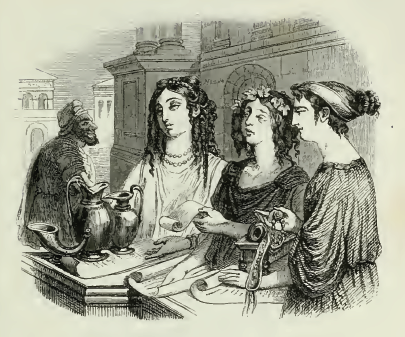
A Person, at his death, left three Daughters; one handsome, and hunting for the men with her eyes; the second, an industrious spinner of wool, frugal, and fond of a country life; the third, given to wine, and very ugly. Now the old man made their Mother his heir, on this condition, that she should distribute his whole fortune equally among the three, but in such a manner that they should not possess or enjoy what was given them; and further, that as soon as they should cease to have the property which they had received, they should pay over to their Mother a hundred thousand sesterces. The rumour spreads all over Athens. The anxious Mother consults the learned in the law. No one can explain in what way they are not to possess what has been given, or have the enjoyment of it; and then again, in what way those who have received nothing, are to pay money. After a long time had been wasted, and still the meaning of the will could not be understood, the Parent, disregarding the strict letter of the law, consulted equity. For the Wanton, she sets aside the garments, female trinkets, silver bathing-vessels, eunuchs, and beardless boys: for the Worker in wool, the fields, cattle, farm, labourers, oxen, beasts of burden, and implements of husbandry: for the Drinker, a store-room, well stocked with casks of old wine, a finely finished house, and delightful gardens. When she was intending to distribute what was thus set apart for each, and the public approved, who knew them well; Æsop suddenly stood up in the midst of the multitude, and exclaimed: “O! If consciousness remained to their buried father, how would he grieve that the people of Athens are unable to interpret his will!”
On this, being questioned, he explained the error of them all: “The house and the furniture, with the fine gardens, and the old wines, give to the Worker in wool, so fond of a country life. The clothes, the pearls, the attendants, and other things, make over to her who spends her life in luxury. The fields, the vines, and the flocks, with the shepherds, present to the Wanton. Not one will be able to retain possession of what is alien to her taste. The Ungainly one will sell her wardrobe to procure wine; the Wanton will part with the lands to procure fine clothes; and she who delights in cattle, and attends to her spinning, will get rid of her luxurious abode at any price. Thus, no one will possess what was given, and they will pay to their Mother the sum named from the price of the things, which each of them has sold.”
Thus did the sagacity of one man find out what had baffled the superficial enquiries of many. [more info]
A Person, at his death, left three Daughters; one handsome, and hunting for the men with her eyes; the second, an industrious spinner of wool, frugal, and fond of a country life; the third, given to wine, and very ugly. Now the old man made their Mother his heir, on this condition, that she should distribute his whole fortune equally among the three, but in such a manner that they should not possess or enjoy what was given them; and further, that as soon as they should cease to have the property which they had received, they should pay over to their Mother a hundred thousand sesterces. The rumour spreads all over Athens. The anxious Mother consults the learned in the law. No one can explain in what way they are not to possess what has been given, or have the enjoyment of it; and then again, in what way those who have received nothing, are to pay money. After a long time had been wasted, and still the meaning of the will could not be understood, the Parent, disregarding the strict letter of the law, consulted equity. For the Wanton, she sets aside the garments, female trinkets, silver bathing-vessels, eunuchs, and beardless boys: for the Worker in wool, the fields, cattle, farm, labourers, oxen, beasts of burden, and implements of husbandry: for the Drinker, a store-room, well stocked with casks of old wine, a finely finished house, and delightful gardens. When she was intending to distribute what was thus set apart for each, and the public approved, who knew them well; Æsop suddenly stood up in the midst of the multitude, and exclaimed: “O! If consciousness remained to their buried father, how would he grieve that the people of Athens are unable to interpret his will!”
On this, being questioned, he explained the error of them all: “The house and the furniture, with the fine gardens, and the old wines, give to the Worker in wool, so fond of a country life. The clothes, the pearls, the attendants, and other things, make over to her who spends her life in luxury. The fields, the vines, and the flocks, with the shepherds, present to the Wanton. Not one will be able to retain possession of what is alien to her taste. The Ungainly one will sell her wardrobe to procure wine; the Wanton will part with the lands to procure fine clothes; and she who delights in cattle, and attends to her spinning, will get rid of her luxurious abode at any price. Thus, no one will possess what was given, and they will pay to their Mother the sum named from the price of the things, which each of them has sold.”
Thus did the sagacity of one man find out what had baffled the superficial enquiries of many. [more info]