Showing posts with label index: Perry 506. Show all posts

The Lamb and the Dog

2.06. De agno et cane
Caxton: Of the wulf and of the lambe
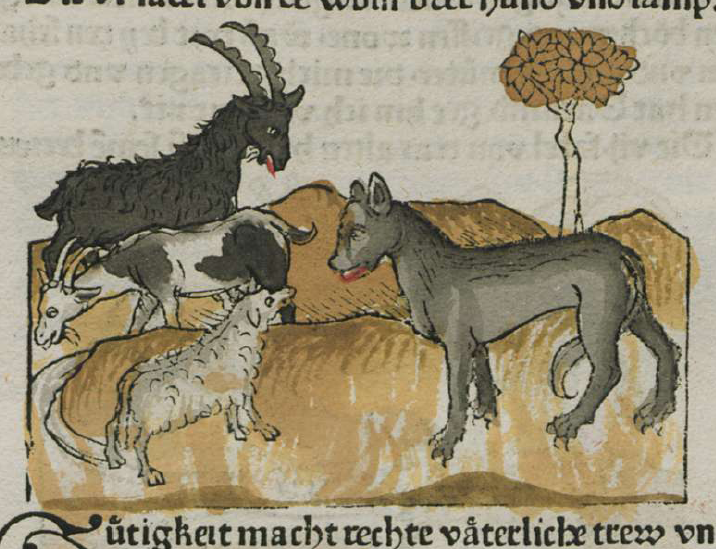
The byrth causeth not so moche to gete some frendes / as doth the goodness / wherof Esope reherceth to vs suche a fable / Of a wulf whiche sawe a lambe among a grete herd of gootes / the whiche lambe sowked a gote / And the wulf wente and sayd to hym / this gote is not thy moder / goo and seke her at the Montayn / for she shalle nourysshe the more swetely and more tendyrly than this gote shalle / And the lambe ansuerd to hym / This goote nouryssheth me in stede of my moder / for she leneth to me her pappes soner than to ony of her own children / And yet more / hit is better for me to be here with these gootes than to departe fro hens / and to falle in to thy throte for to be deuoured /
And therfore he is a foole whiche leueth fredom or surete / for to put hym self in grete perylle and daunger of dethe / For better is to lyue surely and rudely in sewrte than swetely in peryll & daunger
[more info]


The Dog to the Lamb


3.15. THE DOG TO THE LAMB. A Dog said to a Lamb bleating among some She-Goats: “Simpleton, you are mistaken; your mother is not here;” and pointed out some Sheep at a distance, in a flock by themselves.
“I am not looking for her,” said the Lamb, “who, when she thinks fit, conceives, then carries her unknown burden for a certain number of months, and at last empties out the fallen bundle; but for her who, presenting her udder, nourishes me, and deprives her young ones of milk that I may not go without.”
“Still,” said the Dog, “she ought to be preferred who brought you forth.”
“Not at all: how was she to know whether I should be born black or white? However, suppose she did know; seeing I was born a male, truly she conferred a great obligation on me in giving me birth, that I might expect the butcher every hour. Why should she, who had no power in engendering me, be preferred to her who took pity on me as I lay, and of her own accord shewed me a welcome affection? It is kindliness makes parents, not the ordinary course of Nature.”
By these lines the author meant to show that men are averse to fixed rules, but are won by kind services. [more info]

The Lamb Brought up by a Goat


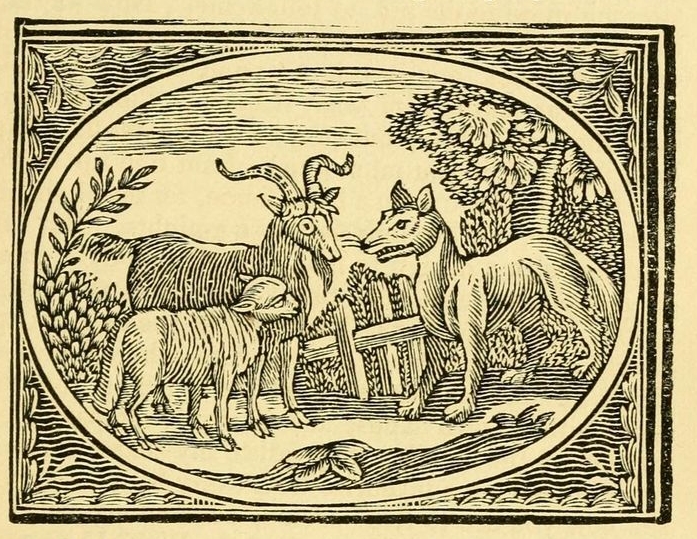
020. THE LAMB BROUGHT UP BY A GOAT. A wolf meeting a lamb one day in company with a goat, “Child,” says he, “you are mistaken; this is none of your mother, she is yonder” (pointing to a flock of sheep at a distance).
“It may be so,” says the lamb; “the person that happened to conceive me, and afterwards bore me a few months in her belly because she could not help it, and then dropt me she did not care where, and left me to the wide world, is I suppose, what you call my mother; but I look upon this charitable goat as such that took compassion on me in my poor helpless, destitute condition, and gave me suck; sparing it out of the mouths of her own kids, rather than that I should want it.”
“But sure,” says he, “you have a greater regard for her that gave you life, than for anybody else.”
“She gave me life! I deny that. She that could not so much as tell whether I should be black or white, had a great hand in giving me life to be sure! But, suppose it were so, I am mightily obliged to her, truly, for contriving to let me be of the male kind, so that I go every day in danger of the butcher. What reason then have I to have a greater regard for one to whom I am so little indebted for any part of my being, than for those from whom I have received all the benevolence and kindness which have hitherto supported me in life.” [more info]

The Dog and the Lamb


3.13. THE DOG AND THE LAMB.
A Dog bespoke a sucking Lamb,
That used a she-goat as her dam,
“You little fool, why, how you baa!
This goat is not your own mamma:”
Then pointed to a distant mead,
Where several sheep were put to feed.
“I ask not,” says the Lamb, “for her
Who had me first at Nature’s spur,
And bore me for a time about,
Then, like a fardel, threw me out;
But her that is content to bilk
Her own dear kids, to give me milk.”
“Yet she that yean’d you sure,” says Tray,
“Should be preferr’d” —“I tell thee nay—
Whence could she know that what she hid
Was black or white?—but grant she did—
I being thus a male begot
’Twas no great favor, since my lot
Was hour by hour, throughout my life,
To dread the butcher and his knife.
Why should I therefore give my voice
For her who had no pow’r or choice
In my production, and not cleave
To her so ready to relieve,
When she beheld me left alone,
And has such sweet indulgence shown?”
Kind deeds parental love proclaim,
Not mere necessity and name. [more info]

The Wolf, The Lamb, and the Goat


015. THE WOLF, THE LAMB, AND THE GOAT. A wolf meeting a lamb one day in company with a goat, “Child,” says he, “you are mistaken; this is none of your mother, she is yonder” (pointing to a flock of sheep at a distance).
“It may be so,” says the lamb; “the person that happened to conceive me, and afterwards bore me a few months in her belly because she could not help it, and then dropt me she did not care where, and left me to the wide world, is I suppose, what you call my mother; but I look upon this charitable goat as such that took compassion on me in my poor helpless, destitute condition, and gave me suck; sparing it out of the mouths of her own kids, rather than that I should want it.”
“But sure,” says he, “you have a greater regard for her that gave you life, than for anybody else.”
“She gave me life! I deny that. She that could not so much as tell whether I should be black or white, had a great hand in giving me life to be sure! But, suppose it were so, I am mightily obliged to her, truly, for contriving to let me be of the male kind, so that I go every day in danger of the butcher. What reason then have I to have a greater regard for one to whom I am so little indebted for any part of my being, than for those from whom I have received all the benevolence and kindness which have hitherto supported me in life.” [more info]

The Wolf and Goat


015. THE WOLF AND GOAT. You will find the fable in English on this page; scroll down to see if there are multiple English versions. [more info]